Giant TCR Advanced vs Advanced Pro vs Advanced SL: What's the Difference and Is the Upgrade Worth It? (New and Used)

On the current TCR (10th generation, since March 2024), Giant says the Advanced and Advanced Pro frames weigh the same (800 g). The Pro gets the lighter SL fork, carbon wheels and usually a power meter. The Advanced SL saves another 110 g in the frame, but it has an integrated seatpost that can't be extended. Used, the Pro is the best deal: on buycycle, a 9th-generation TCR Advanced Pro (model years 2021–2024) sold for a median of only about €370 more than an Advanced. New, the gap is about €1,700.
As of November 2026. Used prices: analysis of about 8,900 TCR listings with a stated grade on buycycle (queried 3 November 2026). New prices: Giant Germany, list prices.
TCR Advanced, Advanced Pro and Advanced SL at a glance
| TCR Advanced | TCR Advanced Pro | TCR Advanced SL | |
|---|---|---|---|
| Frame | Advanced composite, 800 g | Advanced composite, 800 g | Advanced SL composite, 690 g |
| Fork | Advanced grade, 382 g | Advanced SL grade, 330 g | Advanced SL grade, 330 g |
| Seatpost | Variant, carbon, 216 g incl. clamp | Variant, carbon, 216 g incl. clamp | integrated seatpost (ISP) with topper, 107 g |
| Frameset total (Giant's definition, size M, painted) | 1,627 g | 1,610 g | 1,359 g |
| Drivetrain stiffness (frame plus fork) | 136 N/mm (9.7% below SL) | 141.8 N/mm (5.8% below) | 150.6 N/mm |
| Wheels (Giant Germany 2026) | Advanced 1/2: Giant P-R1 alloy | Pro 1 and 0: Giant SLR carbon, 40 mm | Giant SLR 0 or Cadex Max, 40 mm |
| Groupset (Giant Germany 2026) | Advanced 2: 105 mechanical, Advanced 1: 105 Di2 | Pro 1: Rival AXS or 105 Di2, Pro 0: Force AXS or Ultegra Di2, Pro DA: Dura-Ace | Ultegra, Force, Dura-Ace or Red |
| Power meter | no | most builds | most builds |
| New price (Giant Germany) | €2,700 (Advanced 2), €3,500 (Advanced 1) | €5,000 (Pro 1), €6,500 (Pro 0 AXS), €7,999 (Pro DA) | SL 0 at launch in 2024: €12,299 |
All weights and stiffness figures are manufacturer claims from Giant's "TCR Testing" page (model year 2025, size M, Giant's frameset definition including fork, seatpost, headset and paint). Specs and prices vary by year and market; the table shows the German 2026 models. We couldn't check the 2026 SL prices, so the table gives the launch price.
Geometry and tyre clearance (up to 33 mm) are the same across all three grades. The one exception: the SL has an oversized seat tube.
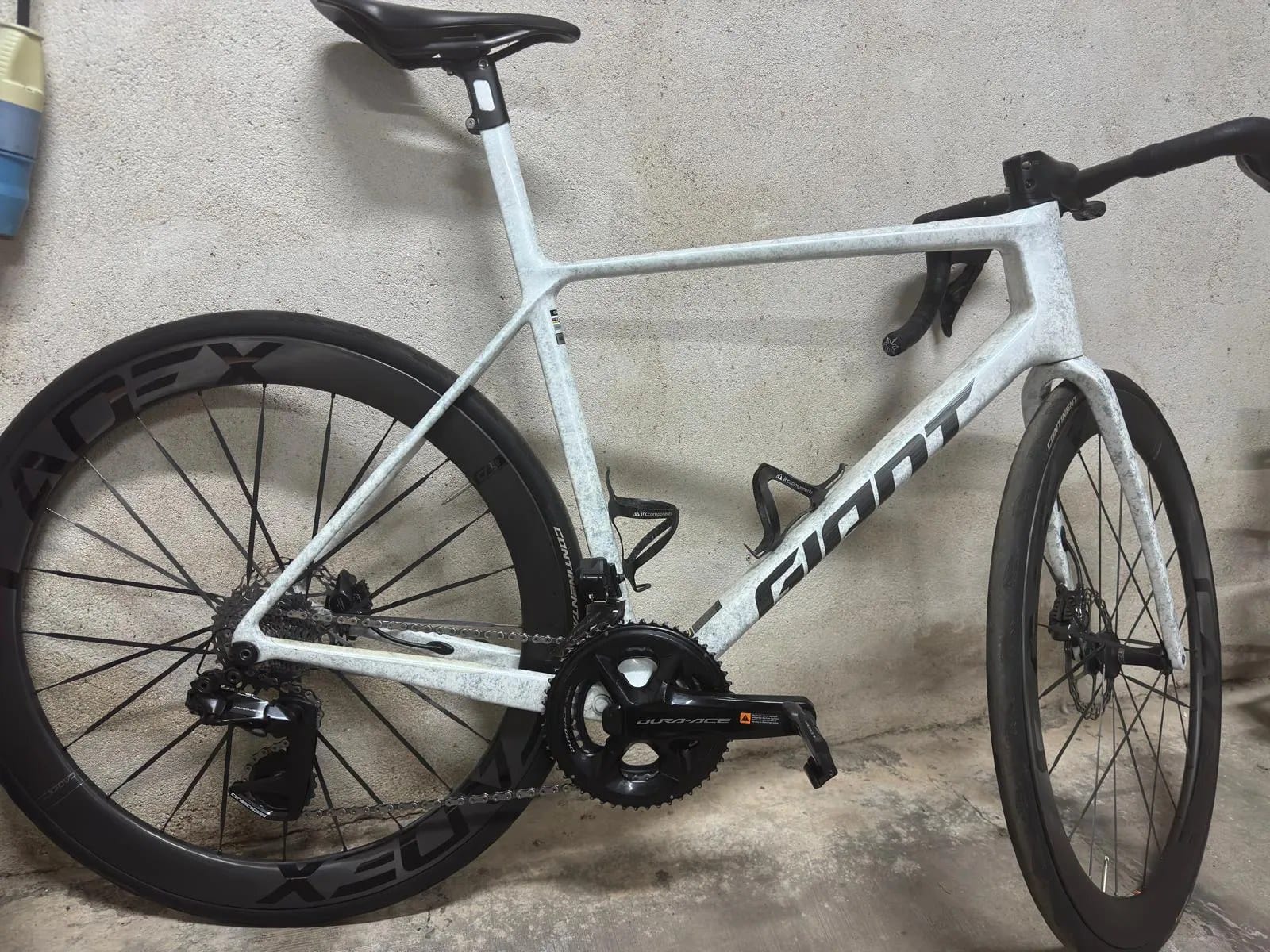
In short: which TCR is worth it?
• You want the cheapest carbon TCR: a used Advanced. Giant lists the same frame weight as the Pro; the differences are fork, wheels and parts.
• You want the lightest TCR and know your saddle height is final: a used Advanced SL. Used, it costs only a little more than the Pro, but it takes longer to find and longer to resell.
• You may resell later or you're unsure about saddle height: go for the Pro. A normal seatpost can be changed, the ISP can't.
What is the difference between the TCR Advanced, Advanced Pro and Advanced SL?
Only the SL has a different frame. Giant's table gives the Advanced and Advanced Pro the same 800 g frame. The Pro differs from the Advanced mainly in fork, wheels, cockpit parts and spec.
- Frame: the SL uses a higher grade of carbon (Advanced SL) and weighs 690 g. Cyclist also reports that the SL's front triangle is made in one piece, while the Advanced and Pro are three bonded pieces. Other sources describe the construction differently, so we don't state this as fact.
- Fork: the Pro and SL have the Advanced SL grade fork (330 g), the Advanced a heavier Advanced grade fork (382 g). That is 52 g.
- Stiffness: Giant measures 136 N/mm (Advanced), 141.8 N/mm (Pro) and 150.6 N/mm (SL) for frame plus fork. The differences are small; you feel them mostly when sprinting out of the saddle.
- Seatpost: the Advanced and Pro have a normal carbon post, the SL an integrated one (ISP).
- Cockpit: Cyclist says all current TCRs have the D-shaped OverDrive Aero steerer with internal routing. According to RennRad (at the 2024 launch), the SL and Pro combine this steerer with Giant's own stem and bar system, while the Advanced uses "semi-integrated" cable routing. If you inspect a used Advanced, look at how the cables run.
- Wheels and groupset: the cheaper Advanced builds have alloy wheels (P-R1); the Pro and SL have 40 mm carbon wheels. They are hookless, so tubeless only.
On the scales: Cyclist weighed a Pro 0 AXS at 7.3 kg (size M/L), bike-x a Pro 1 at 7.66 kg (size M). For the top-spec SL, Cyclist quotes 6.4 kg as a manufacturer claim; we haven't seen it independently weighed.
How much does the Giant TCR Advanced Pro frame weigh?
According to Giant, the TCR Advanced Pro frame weighs 800 g (size M, unpainted), plus 79 g for paint. Including the fork (330 g), seatpost and clamp (216 g), headset and small parts, Giant arrives at a frameset weight of 1,610 g. The Advanced is practically level at 1,627 g, the SL much lower at 1,359 g.
These are manufacturer figures for model year 2025. Paint weight varies by colour and build.
Is the Advanced Pro worth it over the Advanced?
Yes, especially used. New, Giant Germany charges €1,500 more for the Pro 1 (€5,000) than for the Advanced 1 (€3,500). Used 9th-generation Pros sold for a median of €1,900, Advanced bikes for €1,530. The premium shrinks to about €370.
For that you get the lighter fork, on most builds carbon wheels, and a power meter. It's not a frame difference, but these are exactly the parts that would be expensive to retrofit on an Advanced.
On the 10th generation (model year 2025 and newer) the gap is bigger: Advanced at a median of €2,085, Pro at €3,096, so just over €1,000. These figures rest on few sales (43 and 57) and mixed builds, so treat them as a tendency.
Is the Advanced SL worth it? The integrated seatpost (ISP)
Usually not, if price and flexibility matter. Used, the 9th-generation SL costs a median of only about €130 more than the Pro, but it sells much more slowly: after 35.5 days against 11.5.
The numbers from our data (9th generation, model years 2021–2024):
- Advanced Pro: 436 sales, typically €1,900 (about 37% of the new price stated in the listing), sold after 11.5 days.
- Advanced SL: 60 sales, typically €2,028 (about 22% of the new price stated in the listing), sold after 35.5 days.
The reason is the ISP. The post is part of the frame and gets cut to your leg length. For another rider it is often too short afterwards, and it can't be extended. The topper gives some leeway: on the 10th generation there are 45 mm of height adjustment according to Cyclist, and on the 9th generation Giant offers two clamps with 25 and 45 mm (BikeRadar). The ISP is also awkward when packing the bike for travel. Cyclist writes that it "lowers the resale value".
The ISP's advantage according to Giant: it saves weight (RennRad: 40 g less than the previous generation's post), improves aerodynamics and adds comfort. For the whole 10th-generation bike, Giant claims about 4 W less than the 9th.
On older SLs the premium has disappeared. For bikes up to model year 2020, used SLs sell for a median of €1,264, level with the Pro (€1,250), although they cost much more new according to the listings (€5,405 against €3,470). Whether the ISP is the reason, we don't know; it is only a guess.
For the 10th generation there are too few SL sales for a reliable price (10 sales). First listings are around a median of €4,900.
Which TCR generation do I have?
For used buyers the generation matters almost more than the grade. Giant kept selling older generations in cheaper builds for years, and model year and generation don't always line up.
| Generation | Launched | Model years | How to recognise | Tyres | Brakes |
|---|---|---|---|---|---|
| Gen 8 and older | before 2020 | up to MY2020 (MY2016 onwards in our data) | tube shapes from before the "truncated ellipse" of gen 9 | no reliable figure | rim and disc brakes (disc from MY2017) |
| Gen 9 | 7 April 2020 | MY2021–2024 | "truncated ellipse" tubes, cables visible at the stem | up to 32 mm (disc), 28 mm (rim) | rim and disc brakes |
| Gen 10 | March 2024 | MY2025 onwards | cables hidden under the stem, D-shaped OverDrive Aero steerer, 40 mm carbon wheels | up to 33 mm | disc only |
Giant itself calls the current TCR the tenth generation. The model-year boundaries are approximate: dealers sometimes sold the previous series under a newer model year. If in doubt, a Giant dealer can identify the bike from the frame number.
How much does a used Giant TCR cost?
On buycycle, a used TCR Advanced typically sells for about €900 to €2,100 depending on generation, an Advanced Pro for €1,250 to €3,100, and an Advanced SL for €1,260 to €2,030.
Used Giant TCR prices (buycycle, as of 3 November 2026)
| Model | Sales | Typical sold price | New price per listing | Sold after |
|---|---|---|---|---|
| TCR Advanced, gen 10 (MY2025+) | 43 | €2,085 | €3,499 | 12 days |
| TCR Advanced Pro, gen 10 (MY2025+) | 57 | €3,096 | €6,500 | 26 days |
| TCR Advanced SL, gen 10 (MY2025+) | 10 | first listings around €4,900 | €9,999 | too few sales |
| TCR Advanced, gen 9 (MY2021–2024) | 566 | €1,530 | €3,499 | 10 days |
| TCR Advanced Pro, gen 9 (MY2021–2024) | 436 | €1,900 | €5,199 | 11.5 days |
| TCR Advanced SL, gen 9 (MY2021–2024) | 60 | €2,028 | €9,100 | 35.5 days |
| TCR Advanced, gen 8 (MY2016–2020) | 305 | €900 | €2,222 | 8 days |
| TCR Advanced Pro, gen 8 (MY2016–2020) | 351 | €1,250 | €3,470 | 15 days |
| TCR Advanced SL, gen 8 (MY2016–2020) | 88 | €1,264 | €5,405 | 20 days |
Typical sold price = median of bikes actually sold. New price = median of the new price stated in the listings. Generation by model year, grade by listing title (bikes with no grade in the title and e-bikes are excluded). The figures mix frame sizes, builds (0/1/2), conditions and upgraded parts; titles and model years can be wrong. Treat them as a guide, not a price guarantee.
Three things stand out:
- The gap between grades shrinks used. New, the Advanced and Pro (9th generation) are about €1,700 apart, used about €370. Between Pro and SL it is about €3,900 new and about €130 used.
- The SL loses the most. A used 9th-generation SL fetches about 22% of its new price, a Pro about 37%, an Advanced about 44%.
- Pro and Advanced sell fast, usually within 10 to 12 days. The SL takes two to three times as long.
Same budget: a new Advanced or a used Pro/SL?
• New, for comparison: TCR Advanced 2 (€2,700): the same frame weight as the Pro, but mechanical 105, alloy wheels, Advanced fork.
• Used: a 9th-generation TCR Advanced Pro (typically €1,900): SL fork, carbon wheels, usually Di2 or AXS, often a power meter.
Around €3,000–3,500
• New, for comparison: TCR Advanced 1 (€3,500): 105 Di2, alloy wheels, no power meter.
• Used: a 10th-generation TCR Advanced Pro (typically €3,096, 57 sales): current frame, SL fork, carbon wheels, usually with a power meter. Or a 9th-generation SL (typically €2,028) if you accept the ISP; that leaves about €1,000 in reserve.
For the money of a new Advanced you get a higher grade used, and with a 9th-generation Pro there is still money left. Dealer prices on new bikes are sometimes lower in autumn; the table gives list prices.
What to check when buying a used TCR
- Establish the generation. Ask for the model year and frame number. The photo tells you: cables visible at the stem mean gen 9 or older; cables under the stem mean gen 10.
- Check the seatpost (SL). Measure the ISP length and topper against your saddle height. An ISP that has already been cut can't be extended. Ask about the previous owner's leg length and have the length shown.
- Wheels: hookless? Giant's SLR carbon wheels and the Cadex wheels are hookless and tubeless only. Matching tyres and pressure matter; Giant specifies maximum pressures.
- Cockpit and stem. The Giant cockpit isn't a standard part. If stem length and bar width don't fit, a swap gets expensive. The D-shaped spacers (OverDrive Aero) are special parts too; ask how often the steerer has been cut.
- Test the power meter. Most Pro and SL builds include one. Check that it delivers readings and can be calibrated. Some Dura-Ace builds don't have one.
- Frame and fork. Cracks, paint chips with fibres underneath, damage at the head tube. Ask about crashes. More in our used bike buying guide.
FAQ
What does TCR stand for at Giant?
It is usually explained as "Total Compact Road" (RennRad). It refers to the compact frame shape with a sloping top tube that Giant made famous in the late 1990s with the ONCE team. Cyclist writes "Total Compact Racing"; we couldn't find an official Giant statement.
Is the Giant TCR an entry-level road bike?
No. The TCR is Giant's lightweight race bike, ridden by pro teams. The cheapest version (Advanced 2) costs €2,700 new and has a carbon frame. Giant's aluminium Contend is the entry-level road bike.
Which Giant TCR is the best?
The Advanced SL is the lightest and stiffest according to Giant, and the one the pros ride. For most riders the Advanced Pro is the better choice: the same 800 g frame as the Advanced, SL fork, carbon wheels and more choice used.
Which frame size is right for me?
Giant offers sizes XS to XL for riders from about 157 to 199 cm. Which size suits you depends on leg length and riding position; a size chart with standover heights is on Giant's website.
Can you shorten or extend the seatpost on the SL?
You can shorten it, not extend it. The ISP is cut to your leg length. The topper adjusts by 45 mm in height (10th generation, per Cyclist); on the 9th generation Giant offers clamps with 25 and 45 mm.
When did the 10th-generation TCR come out?
Giant presented it in March 2024. The models run from model year 2025.
Should I buy a new or a used TCR?
Used, especially the Pro. A used 9th-generation Advanced Pro costs a median of €1,900 and gives you spec that would cost at least €5,000 new.
More on Giant: Which Giant bike is best? and Giant vs Specialized. The Specialized counterpart to the TCR: Tarmac SL9 vs SL8.
Sources: Giant Bicycles, "TCR Testing Results" (weights and stiffness, model year 2025) and the TCR Advanced and TCR Advanced Pro model pages for Germany (prices, as of November 2026); RennRad, "Giant TCR: Die neue zehnte Version" (6 March 2024); Cyclist, "Giant TCR Advanced Pro road bike review" (1 October 2024) and "Giant Propel vs TCR vs Defy" (updated 15 July 2026); bike-x.de, "Giant TCR Advanced Pro 1 im Test" (17 June 2026); BikeRadar, "Giant launches 2021 TCR" (7 April 2020). Used prices: analysis of about 8,900 TCR listings on buycycle, as of 3 November 2026.
- The buycycle road bike guide
- Best road bike brands
- Aluminum VS Carbon
- Road bike size chart: find the perfect fit
- Are Craigslist bikes or Pinkbike good options to buy a road bike?
Not sure about a road bike yet?
- Mountain bike vs road bike
Our selection of top...
- Best road bikes under 2.000 dollars in 2024
- Top 5 aluminium road bikes
- Top 5 Aero road bikes
Our road bike tests and reviews:
- Cube Agree C:62 Race Review
- Focus Izalco Max 9.8 Review
- Focus Izalco Max 2024 Review
- Specialized Tarmac SL 8 vs. SL 7 comparison
- Specialized Roubaix SL8 Review
- Cube Cross Race VS Cube Nuroad
- BMC Roadmachine Review
- Trek road bike comparison
- Giant road bike comparison
- Canyon Endurace, Ultimate & Aeroad comparison
- Which endurance bike is the best?
Our road bike accessories guides:
- Best road bike saddle: the seats that can’t be beat
- Safe on the bike: All things road bike helmets
- All things (road) bike locks
- All information about clipless pedals
- The buycycle bike computer test
- The bicycle power meter
- Everything about road bike gears
- All about road bike handlebar