
The best jam aids on the bike
With all love... but without a saddlebag, you are only half equipped for your next tour. The faithful companion directly under your butt accommodates all the essentials that keep your spirits high on your trips and save you from annoyances. If you're still wondering or just waiting for the perfect saddlebag packing list, this blog post is for you and your official introduction to the saddlebag.
1. Why do I need a saddlebag?
A saddlebag is a small bag attached to the saddle of a bicycle and thus does not restrict your freedom of movement. Some can be rolled up, others open with a zipper and come in different shapes and sizes. In it, you can store everything you need during a ride, whether a flat tire, a minor injury, or anything on a bike tour. For the most part, however, you are prepared with a well-packed saddlebag and still free of annoying luggage and weight on your body.
2. How big should a saddlebag be?
As so often, it depends on your individual needs. For the vast majority of trips on the bike and smaller excursions, a simple small saddlebag is enough to protect you from breakdowns and the like. But suppose you want to go on a longer bikepacking adventure or want to pack larger tools. A larger saddlebag is a good idea; the additional option of handlebars, frames, or luggage bags is also worth considering. Depending on the packing list and duration of your trip, of course.
3. Can you attach saddlebags to any bike?
In principle, saddlebags can be attached to all types of bicycles, whether mountain, road or gravel bike, but not every type is necessarily proper.
With road bikes, the focus is on minimum air resistance and minimum weight for maximum speed. A large, wide saddlebag is not necessarily a good idea. Instead, consider a small and narrow model that fits snugly.
When MTB a saddlebag is exposed to a lot of dirt and moisture, it should be particularly robust and, in the best case, water-repellent. It is also important that the saddlebag has no protruding loops or the like, with which you can get caught on narrow trail descents on branches.
5. How to mount a saddlebag on the bike?
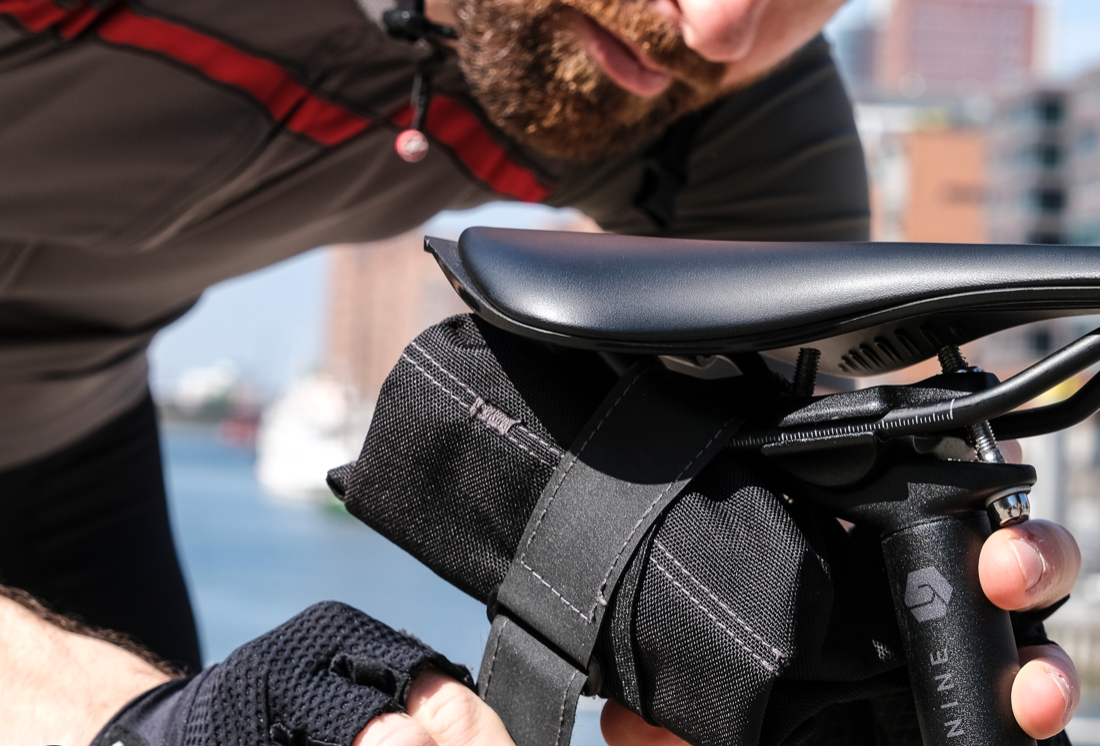
Pretty quick and easy: Most models have fastening eyelets with Velcro. You then attach the eyelet to the seatpost and loop around the saddle rails with the remaining attachment straps. Other models can also be attached by straps, so-called click systems are becoming increasingly popular. The attachment is complicated, but it rarely follows the same principle as Velcro.
6. What do I pack for a bike ride?
So, now you already know almost everything about the saddlebag - but nothing about its contents. Because a well-packed saddlebag can make your ride a lot more pleasant and save you some trouble, Nic has prepared a YouTube video for you, and I have prepared an extra blog article on the subject. Here you can find the blog post, and the video comes directly below:
7. Which saddlebag is the best?
So you do not have to; we have once tested through the most popular models and present our favourites here. So much in advance: When choosing your saddle bag, paying attention to waterproof seams to transport your equipment dry, even in the rain, is best. Reflective elements are also essential because reflectors and a taillight are usually attached at the point of the seatpost, where your bag sits.
Small saddlebags
Vaude Race Light: This saddle bag fits just the most necessary tools. It is, therefore, very light, ideal for a road bike. It is water—and dirt-repellent, and has Velcro attachments. It offers enough storage space for essentials such as a multitool and a spare tube, and has a flashing light holder and reflectors attached.
Toepak Aero Wedge Pack Strap: This bag has reflective stripes, a flashing light holder, and Velcro attachments. It offers enough storage space for essentials such as a multitool, spare tube, and energy bar.
EVOC Seat Bag M: Available in various colors, this very light bag is attached by a clamping system and has just the necessary space.
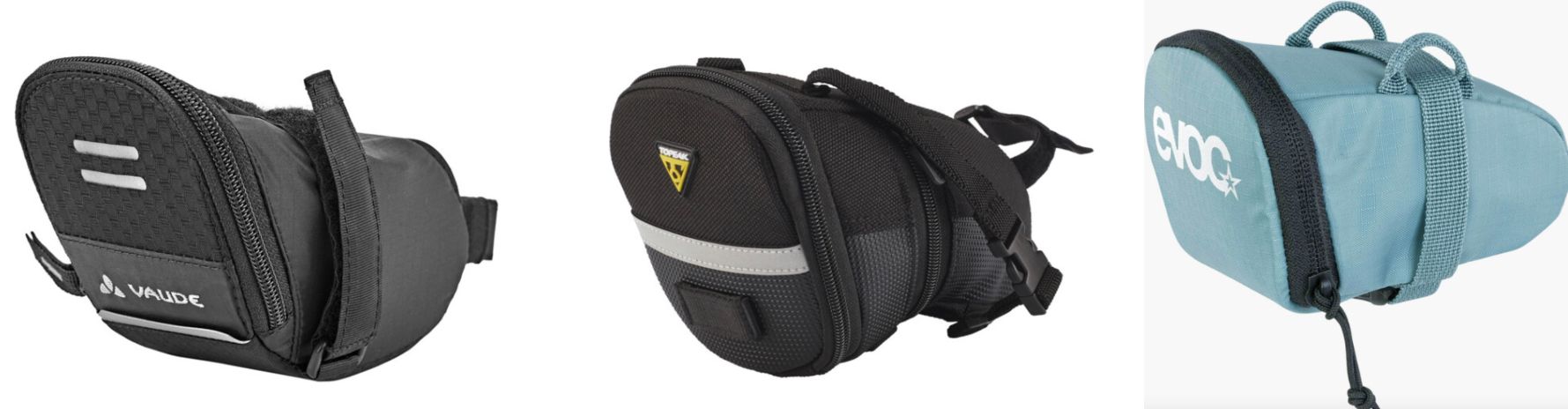
KlickFix Micro Sport: This model is available in three different sizes, but all have a reflector and a KlickFix saddle adapter. Thus, the saddlebag can also be mounted easily and quickly on sports saddles.
Large saddlebags
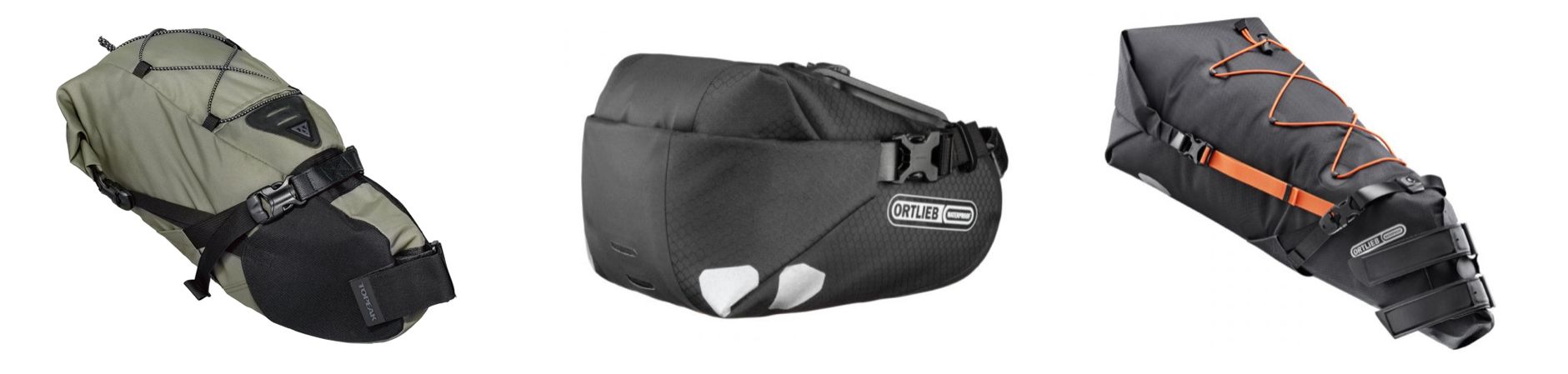
Topeak BackLoader: This saddle bag offers a 15 L luggage volume. It is attached by Velcro fasteners so that the pendulum effect is reduced while riding, and you hardly notice the extra weight. It is also water repellent and has an extra waterproof inner bag.
Ortlieb Saddle Bag Two: Thanks to an adapter, the 4.1 L volume bag can be (dis)mounted extra quickly on a bike. In addition, the Paddle Tag Two is waterproof and has a roll closure. Reflectors are located on the side.
Ortlieb Seat-Pack: This saddle bag is ideal for bikepacking. It's roomy, waterproof, has a roll-top closure, and is extremely durable. It holds 16.5 L. Drawstrings on the top of the bag provide extra space.
So what are you waiting for? Get a saddlebag mount, power bar, spare tube, and multitool and start cycling!
For more questions about the saddlebag, your packing list or the general cycling topic, you'd browse through the blog. Also the buycycle-team is happy to help you.buycycle.com is always worthwhile, after all, nowhere else is it so easy, fast and safe to sell your old bike or find the new old bike of your dreams. Until then, we wish you, as always, happy browsing and cycling!
Bike Saddlebags Review | buycycle
Without this gadget, you are only half equipped for the next bike ride: the saddle bag. It is an absolute must-have on every ride. Once the saddlebag is packed sensibly, it saves you time and nerves. Because with the right contents, the saddlebag can help you out of trouble in many unforeseen situations. Here you can find out how the saddlebag becomes a savior in an emergency and which model suits you.
What is a saddlebag? A saddlebag is a small bag attached to a bicycle's saddle. It is usually used to carry things that you need on a ride. They come in different shapes and sizes. Some can be rolled up, while others open with a zipper. At the same time, the saddlebag does not get in the way, it does not restrict your freedom of movement during the ride and offers more storage space than you would expect at first glance.
What do I need a saddlebag for? A saddlebag can hold things essential for a bike ride. During the trip, unpredictable situations such as a flat tire or injuries can occur repeatedly. To be equipped for this, it is worthwhile to pack a saddlebag with useful contents and always leave it on the bike. This will save the annoying gathering of useful individual parts before the next bike use.
In addition, you do not notice the weight of the items when they are stowed in the saddlebag. If you were to carry the contents in a backpack, it would be different. How big should a saddlebag be? The ideal size of a saddlebag depends on the individual needs of the user. Usually, a small saddlebag is enough to carry everything important in case of a breakdown. What exactly that is, you will learn further down in the text. However, those who go on a bikepacking adventure or want to carry larger tools with them can resort to larger models.
Many manufacturers offer nifty options for this. When bikepacking and on more extended tours, you want to stow equipment needed for several days on the bike. Here, one usually falls back on additional bike bags such as the handlebar bag, frame bag, luggage carrier bag and other bikepacking bags. This creates enough space to carry the necessary clothing, food or camping equipment on long trips.
Can you attach saddlebags to any bike? Saddlebags can be attached to all types of bicycles, whether a mountain bike, a road bike or an e-bike. Road bikes, with their narrow tires, tend to get flat tires. To be able to fix this problem on the road, it is worth carrying a saddlebag. However, before buying a bike, one should remember that, especially when riding a road bike, the focus should be speed. Therefore, a small and narrow model that catches little wind and thus does not rob the bike of aerodynamics is recommended. In addition, the ideal bike bag for the road bike should have a tight-fitting attachment system.
A saddle bag is also important for the MTB. After all, you quickly get so-called snake bites or other punctures, especially off-road. Here, too, the right tool is indispensable. When driving an MTB, the saddlebag can be exposed to a lot of dirt and moisture, so it should be particularly robust and, in the best case, water-repellent. It is also vital that the saddlebag has no protruding loops or the like, with which you can get caught on branches on narrow trail descents.
For e-bikes, all conventional saddlebags are suitable; no special model is needed. Since many kilometres can be covered easily, the probability of a breakdown increases, especially on the E-bike. Therefore, the right equipment is also indispensable here. You will learn what exactly should be in your saddlebag under the point "Saddlebag Essential".How do I mount a saddlebag on the bike?
Mounting the saddlebag is quick and easy. Most models have fastening eyelets with Velcro. First, you attach an eyelet to the seat post so that it can not fall off. Then the other fastening tabs can be attached from the inside to the saddle rails under the bicycle saddle. In doing so, you should not close the Velcro straps too tightly, so that you do not remove any storage space from the bag. In addition to mounting by Velcro, there are other variants of seatposts. For example, they can be attached by straps; therefore, a similar procedure is required for Velcro fasteners. Also, so-called click systems are becoming increasingly popular. If you buy a saddlebag with a fast-lock system, a detailed manual on attaching the bag is included.
Saddlebag Essentials: Pack these things for a bike ride! The saddlebag offers capacity for items that can help in an emergency. To be prepared for the most common incidents, we have prepared a list of helpers that every cyclist should have on every ride. Tire lever: Tire levers are an absolute must to fix a flat tire efficiently. Tire levers are a kind of lever that helps you lever the tire from the rim bed or re-tension. Even if you have the strongest hands in the world, a tire lever will make your job much easier and save you a lot of time. They come in various sizes, so make sure you pick a size that will fit in a saddlebag.
Nevertheless, as with all levers, the longer this is, the greater the leverage.Spare tube: When you're on the road, a suddenly flat tire is the last thing you want. With a reliable saddlebag, you'll be prepared for any situation on the road. Pack a spare tube for this. When you remove the tube from the box, keep the rubber band around it so it stays nice and tight.
If you've already used up your spare tube in the event of a puncture, here's a tip: There are vending machines on the front of many bike stores where spare tubes can be purchased. Ensure you buy the right size and valve that fits your bike. CO2 cartridges or mini hand pump: Once you've replaced a punctured hose with a new one, it's time to pump it up. CO2 cartridges are a convenient and quick way to inflate your hose. They're small and easy to carry, and the inflation nozzle is compact, too.
In seconds, you can get plenty of air into your tire without spending a long time using a bicycle pump. However, we recommend a mini hand pump if you're looking for a cheaper and more eco-friendly option. However, you may then need a larger saddlebag. Repair kit: If you're unlucky enough to suffer multiple punctures in one ride, a patch kit in your saddlebag can be a lifesaver.
Also, if you pass another cyclist with problems on your ride, having a patch kit is often a big help, as unfortunately, not all bike enthusiasts are as well equipped. These kits are small and easy to carry and can help you fix that punctured tube so you can ride again. Even if you don't plan on using them, it's better to have them and not need them than to need them and not have them. If you ride tubeless, a tubeless repair kit is an excellent alternative to a patch kit.
Multitool: Even if your bike does not require a multitool to remove the wheels, having one with you on every ride is still a good idea. The multitool has the necessary tools installed, with which you could theoretically disassemble your entire bike. Standard tools include the Allen key in various sizes, a chain riveter to ream out broken plates, a Torx 25 insert, and slotted and Phillips screwdrivers.
Countless components on your bike can shift or come loose. A multitool is often the best way to fix these problems quickly and easily. There are many multitools available, so be sure to buy one that fits your needs and is compatible with the screws on your bike.
More extras: Besides these basic things, depending on the size of the bag, you can also pack a small first aid kit, some gloves or wet wipes in case you need to fix a chain that fell off. Using these tools is better than smearing your bike and clothes with grease. Rations such as energy bars, power gel, or similar are also handy for short tours. Depending on the volume, it can also store a small foldable rain jacket. Saddlebags are also suitable for carrying valuables such as smartphones or cash.
When you move away from the bike, you should take these things out of the bag. Exactly which things you pack depends on your personal preferences and needs. Which saddlebag is the best? Here is a little buying advice for you, based on test reports. Depending on the application, your ideal saddlebag differs in size and shape. Some practical things must not be missing. For example, waterproof seams are essential to transport your multitool or cash dry even in the rain.
Also, the saddlebag is so remarkably durable. Reflective elements are also important, because in the place of the seatpost should usually be reflectors, and a taillight is attached. Many suppliers have developed practical models. There are also models with integrated bottle cages, where you can easily grab your water bottle while riding. On multi-day tours, every water bottle you can carry on your bike counts more. If your bike has a luggage rack, you should ensure the saddle bag is not attached too close to it.
Vaude, Ortlieb, Topeak, Klickfix, RockBros, Deuter, Evoc and Rixen & Kaul are among the most popular bicycle saddlebag variants. Here we present the best saddlebags that many testers have found to be very good. Small saddlebags Vaude Race Light: This saddle bag fits the necessary tools. It is therefore very light and is attached by Velcro.
Designed for the road bike, the saddlebag can also be mounted on any other type of bike. It includes a flashing light holder and reflective elements. It is water—and dirt-repellent. Toepak Aero Wedge Pack Strap: This bag from Topeak has reflective stripes, a holder for an optionally available LED, a large opening, and is attached by Velcro to the seatpost. It offers storage space for essentials such as a multitool, a spare tube, and an energy bar.
EVOC Seat Bag M: The saddle bag from Evoc is available in various modern colors. A clamping system attaches it and is very light. Through a buckle, it can be mounted. Here, too, has just the most necessary space, and the bag is also very light.KlickFix Micro Sport: This model is available in three different sizes. They include a reflector and a KlickFix saddle adapter. This allows the saddle bag to be mounted on sports saddles. Through a click system, the bag is attached. The attachment is fast and straightforward.
Large saddlebags Topeak BackLoader: This saddle bag offers a 15 L luggage volume, making it a good alternative to luggage racks and protecting like a fender. The mounting system reduces the pendulum effect during the ride, and you hardly notice the movement of the extra weight while cycling. The saddlebag is water repellent with a waterproof inner bag. Velcro fastens it and has a rear light holder.
Ortlieb Saddle Bag Two: The Ortlieb Saddle Bag Two has a lot of volume, 4.1 L to be exact. Thanks to an adapter, the attachment to the bike is quick to make. If the bag is not always there, then no holder must be dismantled. For this, the bag has a practical click system. In addition, the Paddle Tag two is waterproof and has a roll closure. Reflectors are located on the side.
Ortlieb Seat-Pack: This saddle bag was created for bikepacking. It is spacious, waterproof, has a roll closure, and is highly robust. A total of 16.5 L fits in here. Cord suits on top of the bag provide extra space for equipment. Due to the bag's shape, it also serves as a fender and can be mounted on any bike with a fixed seatpost.
Components guide
- Bike components guide: what are the parts of a bike?
- What bike parts to upgrade first?
- How much do bike parts cost?
- Where to buy bike parts?
- What are the main gravel bike parts? Check out our guide to gravel bike components!
- What are the main mountain bike parts? Check out our guide to mountain bike components!
- What are the main road bike parts? Check out our guide to road bike components!
- How to convert a road bike to a gravel bike? Is that even a good idea?
- All things suspension travel
Gearing system
- Everything you need to know about the Shimano Di2
- Shimano Claris review: lifting the lid on the Shimano’s most accessible road bike groupset
- All about the Chinese L-TWOO eRX shifting group
Wheels and tires
- Tubeless tires - What are the advantages?
- Going Tubeless
- Gravel tires on road bike: A genius move or a misguided choice?
- Schwalbe tires recycling
- Everything about the tire size of your bike
Breaks
Pedals
Saddles
- Best MTB saddles: saddle up for the trails
- Best road bike saddle: the seats that can’t be beat
- How to calculate your ideal saddle height
Bags
Electronics
- The best bike gadgets 2024
- The buycycle bike computer test
- Everything about road bike gears
- The bicycle power meter
Bike Maintenance
Others