What are my used skis worth? The 2026/27 price guide

The short version
- Used skis fetch a median of €280, snowboards €250, ski and touring boots €180.
- As a rule of thumb, well-kept winter gear brings in about a third of its original retail price, averaged across all model years.
- Condition is your biggest lever: skis in very good condition fetch a median 70% more than ones in acceptable condition.
- Selling on buycycle is completely free — no commission, no listing fee. The buyer pays the shipping.
The skis have been in the basement for two seasons. The binding is still fine, the base has a few scratches, and the boot box is around here somewhere. The question is always the same: is it even worth selling, or is this stuff just bulky waste now?
Online you mostly get a shrug in response. "Depends on the condition." "Have a look in the forums." We can be more precise, because we see it: over the 2025/26 season, thousands of winter sports people sold their gear through buycycle. This guide shows you what was actually paid — and how to work out the right price for your own kit from it.
Why sell your winter gear on buycycle
Selling costs you nothing
No commission, no listing fee, no hidden costs. What the buyer pays for your skis is what reaches you. That is the key difference from consignment arrangements at sports retailers, where depending on the shop a third of the proceeds stays behind the counter.
The buyer pays the shipping
You do not front the postage or work it into your price. You pack, the buyer covers the transport.
Payment is secured
The money is held before you let the skis go. No meeting in a car park, no cash, no chargeback risk.
Buyers across Europe
Your 176 cm all-mountain skis may not interest anyone in your neighbourhood — but they will interest someone in Tyrol, South Tyrol or Switzerland. That is exactly the difference between a local classifieds market and a platform with European reach.
1. What actually sets the price of your skis
Three factors decide the price. In this order.
The category
Skis and snowboards hold their value considerably better than clothing or accessories. A pair of touring skis is still a serious piece of sports equipment after four years. A four-year-old ski jacket is mostly a jacket.
The condition
The biggest lever you actually control — and the only one you can still change before selling. More on that below.
How recognisable the model is
A clearly named model with a year and a length sells better than "skis, barely used". Buyers search for specific model names. List yours as "all-mountain 170" and you simply will not appear in that search.
2. What used skis and snowboards actually fetched
All figures are median values from completed sales on buycycle over the 2025/26 season. The median says more than an average, because a few very expensive sales cannot skew it. The "typical range" covers the middle 50% of all sales — a quarter sold below it, a quarter above.
| Category | Median price | Typical range | Days to sell |
|---|---|---|---|
| Skis (alpine & touring) | €280 | €200 – 400 | 23 |
| Snowboards & splitboards | €250 | €138 – 395 | 17 |
| Ski & touring boots | €180 | €100 – 200 | 23 |
| Ski jackets | €133 | €68 – 230 | 36 |
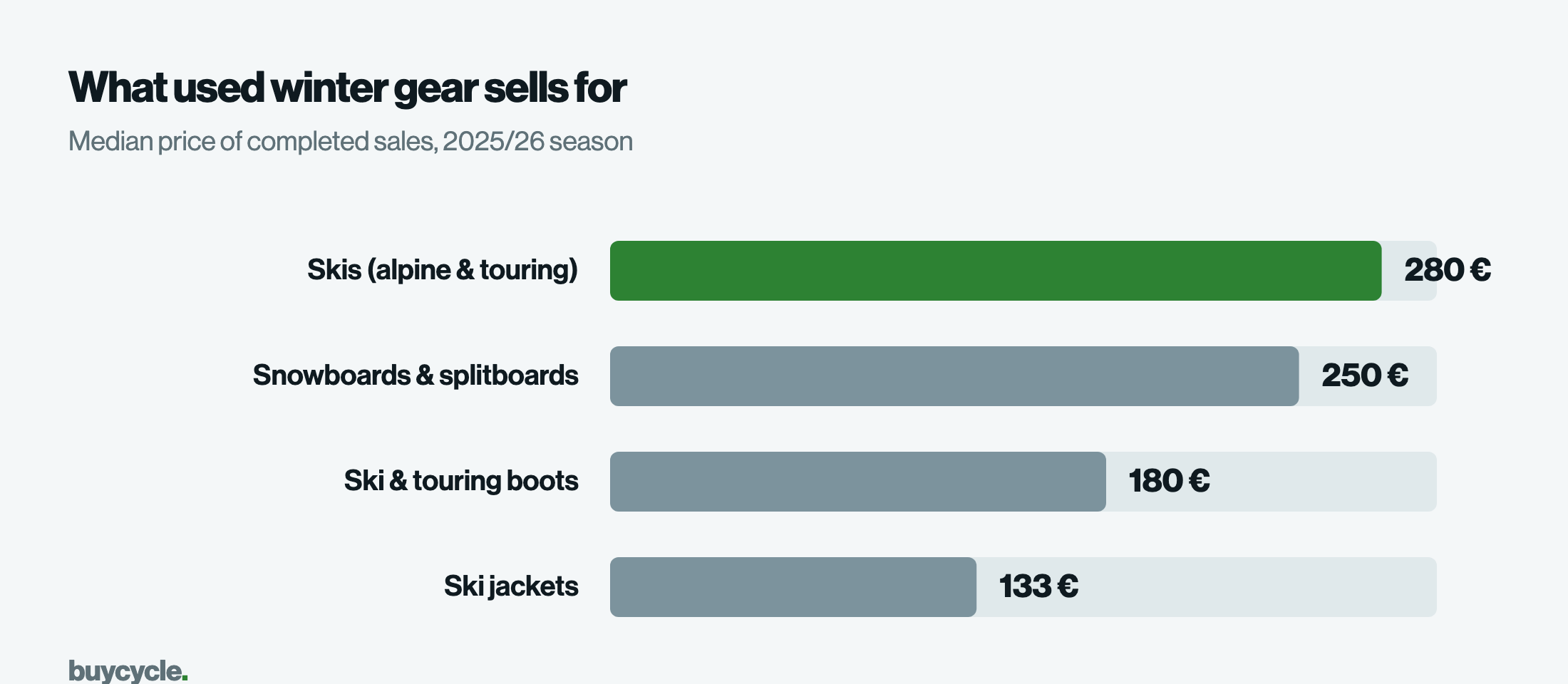
Two things stand out.
Snowboards sell fastest. A median of 17 days, quicker than skis. If you have a board to move on, the demand is there.
Clothing takes longer. A ski jacket sits online for a good five weeks at the median. That is not a reason to leave it in the wardrobe — it is a reason to list it early rather than in January.
3. Condition is your biggest lever
This is the difference you can actually influence. The step between condition grades is substantial:
| Condition | Median price | Days to sell |
|---|---|---|
| New | €250 | 35 |
| Very good | €220 | 22 |
| Good | €200 | 21 |
| Acceptable | €130 | 16 |
There is €90 between "very good" and "acceptable" — within the same category. Anyone who strips their skis down after the season, looks after the edges and has the base repaired sells them for noticeably more later. That is not a marketing line, it is the gap between two rows of this table.
The top row is the interesting one. Factory-new gear achieves the highest prices but sits online the longest — 35 days against 22 for "very good". People who deliberately buy second-hand are looking for a good deal, not new equipment at close to new prices. So if you have unused skis from a bad purchase to move on, be realistic about your asking price or you will wait longer than you need to.
4. What your brand is worth
Brand shapes the price less than most people expect — category and condition weigh more. There are still clear differences:
| Brand | Median price | Days to sell |
|---|---|---|
| Black Crows | €350 | 25 |
| Atomic | €343 | 27 |
| Head | €288 | 33 |
| Rossignol | €260 | 17 |
| K2 | €239 | 33 |
| Völkl | €220 | 24 |
| Salomon | €200 | 24 |
Premium brands from the racing and small-manufacturer end sit considerably above that again. If you have a pair of Stöckli or something comparable in the basement, do not underestimate what it is worth.
Rossignol is the most interesting entry in this table: a solid median price at only 17 days on the market. Well-known models with wide distribution find a buyer quickly.
5. What matters less than you think
Three factors sellers consistently overestimate:
The original retail price
"These cost €900 once" is understandable but irrelevant to the buyer. What counts is what comparable skis cost today — and for an eight-year-old top model that is often less than for a two-year-old mid-range one.
The original box and accessories
With electronics, original packaging raises the value. With skis it does not. Nobody pays for the box — and a ski bag is a nice extra, not a pricing argument.
A single scratch
Used skis are allowed to look like used skis. Buyers shopping second-hand expect signs of use — they only expect to see them in advance. A documented scratch costs you almost nothing; a concealed one costs you the sale.
6. Three steps to the right price
Step 1: find the retail price
Search for your model with its year — something like "Völkl Kendo 88 2021". You will almost always find the original RRP. Write it down.
Step 2: start at a third
Across all model years, used winter gear achieves a median of roughly a third of its retail price. With an RRP of €700 that puts you at about €230 as a starting point. If your gear is only a year or two old you will be well above that; for eight-year-old skis, correspondingly below.
Step 3: adjust for condition and cross-check
Very well kept and barely skied? Upwards. Base deeply scratched, edges rusted? Downwards. Then look at what comparable skis currently cost on buycycle, and whether your figure sits inside that range.
When you list, our price suggestion also helps — it draws on comparable completed sales. You do not have to settle on a number alone.
Conclusion
Used winter gear is worth more than most people assume. A pair of skis in the basement is a median €280, a snowboard €250 — money that does nothing while it sits in the basement. Condition is the factor in your hands: there is easily €90 between looked-after and neglected.
And because selling on buycycle costs you nothing and the buyer pays the shipping, the price you achieve is the price you keep.
If you want to get on with it: the complete guide to selling skis walks through the whole process. How to get your gear listing-ready is covered in getting your skis ready to sell — and when to list is something we worked out in the data check on the best time to sell.
Frequently asked questions
How much are my used skis still worth?
A median of €280, with the middle 50% of all sales falling between €200 and €400. As a rule of thumb, used winter gear achieves around a third of its original retail price — more if it is newer and in very good condition.
Do skis lose value quickly?
The steepest drop happens in the first two seasons. After that the curve flattens: a six-year-old ski in good condition is not dramatically less valuable than a four-year-old one. From that point on, condition decides, not the model year.
Is it even worth selling old skis?
Yes — as long as the binding can still be adjusted. Even gear in acceptable condition achieves a median of €130 and sells quickly, because it speaks to exactly the buyers who are watching the price.
How does the age of the binding affect the price?
Considerably. Bindings drop off manufacturers' service lists after roughly ten years, and workshops will then refuse to adjust them. Skis with a binding like that are best sold honestly as "without binding" or with a clear note — it is fairer and saves a round of questions.
Will I get more if I sell skis and boots together?
Usually not. Boots are a fit decision, skis are a feel decision — very few buyers are looking for that exact combination. Listed separately you reach two audiences instead of one.