How to sell your skis: the complete guide

The short version
- On buycycle you sell your skis for free — no commission, no listing fee. The buyer pays the shipping.
- Used skis fetch a median of €280 and are sold in about 23 days.
- List as soon as you're ready — an early listing is already visible once buyers start searching in November.
- Four details decide whether your listing works: length, model year, binding model and the sole length it is set to.
Selling skis is straightforward — once you know where, when and how. This guide takes you through all four: choosing the platform, the right price, the right timing, and the listing itself.
1. Where can I sell my skis?
You have essentially four options. Each has its place — it depends on what matters more to you: speed, proceeds, or convenience.
Classifieds
Free and quick to post. The drawback is reach: you are mostly reaching buyers nearby, and for skis the local audience is small. Then there is the effort — viewings, haggling, handing over cash. There is no protection against non-payment.
Trade-in at a sports retailer
Some shops take used winter gear directly. It is quick and you are rid of it immediately. The price sits well below market value, though, because the shop has to recondition the gear and resell it at a margin. Often you get a voucher rather than cash, so the proceeds stay in the shop.
Ski swaps and consignment
The classic route in the Alpine countries. With consignment through a sports shop, roughly a third of the price achieved stays with the retailer depending on the house. Ski swaps run by clubs and shops usually happen once a year on a fixed weekend — miss the date and you wait another year.
buycycle
You list your skis, a buyer somewhere in Europe buys them, you ship them. Selling costs you nothing: no commission, no listing fee. The buyer pays the shipping, and the money is held before you hand over the parcel.
The real difference is reach. Your 178 cm freeride skis may find nobody in your neighbourhood — but in Tyrol, South Tyrol or Switzerland they will. That is what a Europe-wide platform is for.
| What it costs you | Reach | Payment secured | |
|---|---|---|---|
| Classifieds | free | local | no |
| Retailer trade-in | a discount on the price | – | yes |
| Consignment | about a third of the proceeds | local | yes |
| buycycle | free | Europe-wide | yes |
2. What are my skis worth?
Used skis achieve a median of €280 on buycycle, snowboards €250, ski and touring boots €180. As a rule of thumb, well-kept gear brings in around a third of its original retail price.
The biggest lever is condition: gear in very good condition achieves a median of €220, acceptable condition only €130. So there is roughly €90 between looked-after and neglected.
How to work that into a concrete figure for your own pair is covered in detail in the price guide for used skis.
3. When should I list my skis?
List as soon as you're ready — even in late summer. Buyers simply show up a little later than sellers, which just means your listing has time to get seen and polished before the season's search volume arrives.
Gear listed in November sold in a median of 17 days, in May 59. The fastest window runs from November to February — which is exactly why it pays to have your listing live and dialed in well before it starts.
The month-by-month figures are in our analysis of the best time to sell skis.
4. Getting your skis ready to sell
A good hour of work before the listing pays off. In short:
- Collect the details: length, model year, radius, binding model and the sole length it is set to.
- Check the condition: base, edges, binding function, screws.
- Clean: strip the base, take the rust off the edges, clean the binding.
- Photograph: in daylight, against a neutral background.
The full walkthrough is in our guide to getting your skis ready to sell.
5. The listing: the details that decide
Buyers of winter gear search very specifically. There are four details you should never leave out:
Length in centimetres
The single most important number. It is usually printed on the tip or at the waist.
Model name and model year
"Völkl Kendo 88, 2021 model" beats "all-mountain skis, barely used" by a distance. The model name is the term people actually search for.
Binding model and DIN range
The adjustment range decides whether a buyer can use the binding at all. A range of 3 to 11 suits most adults; a racing range starting at 8 does not suit a child.
The sole length it is set to
The detail most often missing and most often asked about. It is printed on the binding and tells the buyer whether their boot fits without a trip to the workshop.
Add a sentence about how the skis were used — how many ski days, what terrain, whether they were serviced regularly. That builds more trust than any superlative.
6. Setting and negotiating the price
Set the price slightly above your walk-away figure, but within reason. A listing 40% above comparable offers does not get negotiated — it gets skipped.
How to handle offers
Buyers often ask for a discount. Two things help you stay relaxed about it:
- Answer promptly. Someone waiting two days for a reply has usually looked elsewhere already.
- Justify your price. "The skis were serviced twice and the binding has a current adjustment range" lands better than a bare no.
When to drop the price
If your listing has produced no enquiries after three or four weeks in peak season, something is usually off — most often the price, sometimes the photos. A cut of 10 to 15% brings a listing back into view. In summer this explicitly does not apply: silence is normal then and tells you nothing.
7. The most common mistakes
Four patterns show up in the listings that sit unsold:
The length is missing
Buyers filter by length first. Without it your listing appears in no filtered search, however good the skis are.
The price is anchored to the retail price
"They cost €900 once" is irrelevant to the buyer. What counts is what comparable skis cost today.
Flaws are left out
A scratch the buyer discovers on unpacking leads to a return. The same scratch, visible in the listing, leads to a sale.
Listed too late
Start cleaning the skis in February and you are online in March — at the end of the demand window.
8. Shipping and payment
Finding a box
Skis need a long box. The simplest source is your local sports shop: skis arrive there in exactly those boxes, and most retailers will hand one over free if you ask. Alternatively, two sturdy boxes can be slotted together and reinforced with packing tape.
Packing properly
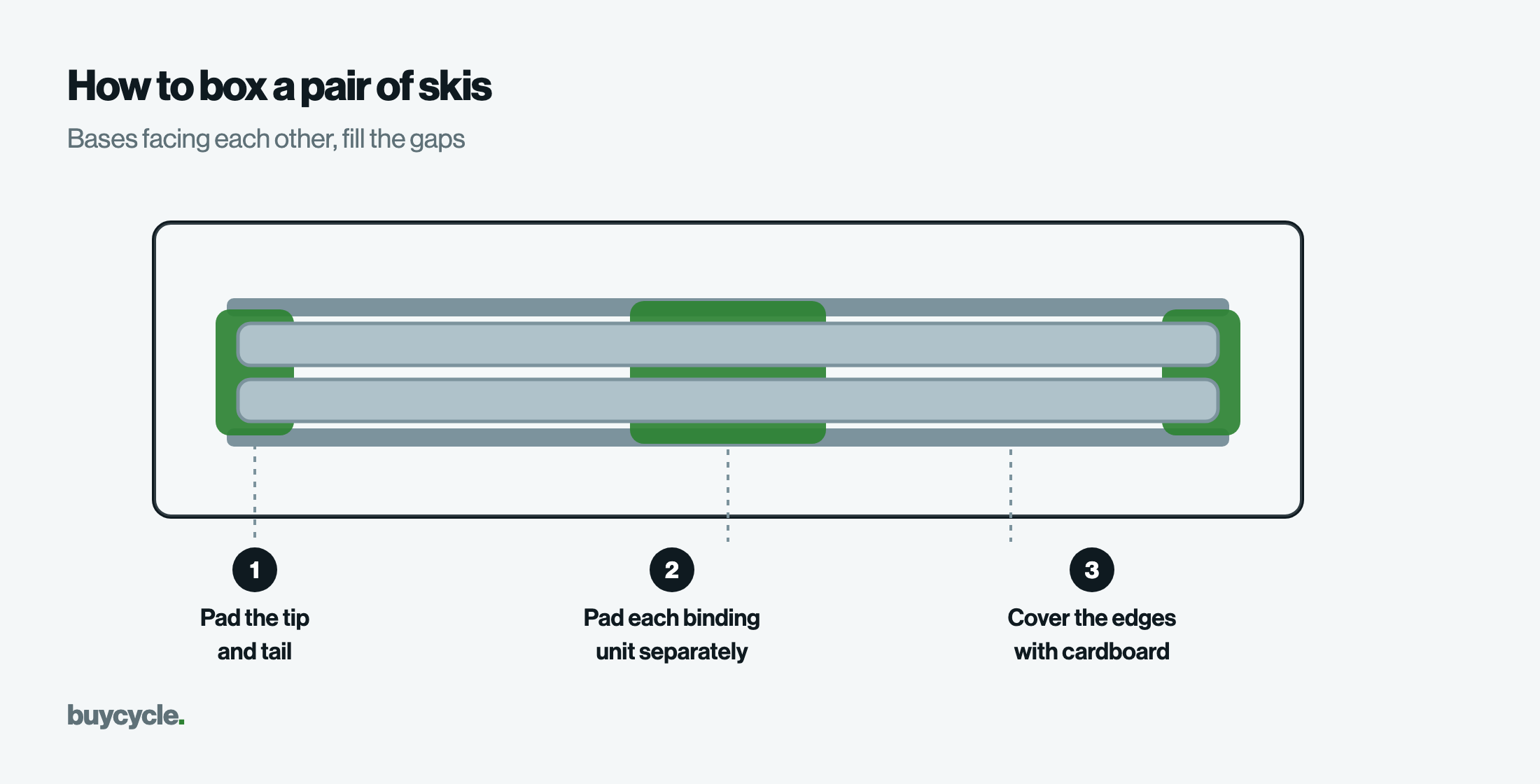
Three places matter:
- The edges. They are sharp and will cut through cardboard in rough transit. Lay corrugated card or foam along both edges.
- Tip and tail. The most vulnerable points. Wrap generously in bubble wrap.
- The binding. Pad the toe and heel units separately so they cannot press into the second ski inside the box.
Then put the skis together with the bases facing each other, secure them with straps and fill the void in the box so nothing shifts.
Payment
The buyer covers the shipping. The money is already held before you hand over the parcel, so you never ship on trust. Once the shipment arrives, the amount is released to you.
Conclusion
Selling used skis rarely fails because of the market and usually comes down to a few small things: an incomplete listing, a price with no connection to reality, or waiting too long to get it online. Prepare the gear properly, list as soon as it's ready, include the four decisive details, and let the demand that picks up from November find you already there.
And since selling on buycycle costs nothing and the buyer covers the shipping, the price you achieve stays with you in full.
Frequently asked questions
Where is the best place to sell my skis?
It depends what matters to you. For the highest proceeds with manageable effort, a Europe-wide platform with no selling fees is the best choice. If you want it done fast and without shipping, a local trade-in or classifieds is more convenient but pays less.
What does selling on buycycle cost?
Nothing. There is no commission and no listing fee, and the buyer pays the shipping. The agreed price goes to you in full.
How do I ship skis safely?
In a long box, with the edges and tips padded and the binding units protected separately. Sports shops will usually give you a suitable box for free.
Can I sell skis together with the binding?
Yes, and in most cases it makes sense: skis with a mounted binding are ready to use straight away. What matters is stating the binding model, the DIN range and the sole length it is set to.
How long does it take to sell skis?
A median of 23 days. Listing in the main season between November and February sells noticeably faster than in spring or summer.