How do I get my skis ready to sell? A complete guide

The short version
- Skis in very good condition fetch a median of €220, acceptable ones only €130 — a good hour of preparation is real money.
- The four details buyers actually need: length, model year, binding model, the sole length it is set to.
- Bindings older than about ten years are no longer adjusted by workshops. Say so in the listing — the buyer will find out anyway.
- Seven photos are enough, if they are the right seven.
There is less work between "skis in the basement" and "skis sold" than most people think — but it is the work that decides the price. This guide takes you through the preparation in five steps.
Why the preparation pays
Between the condition grades "very good" and "acceptable" there is a median of around €90 on buycycle. Part of that is genuine wear you cannot undo. Another part is simply presentation: a stripped base rather than dull scratches, clean edges rather than brown streaks, a clean binding rather than dried road salt.
1. Collect your ski's details
Before you clean or photograph anything, gather what belongs in the listing. Winter sports buyers search extremely specifically, and a listing without these details is simply skipped.
Length, model, year
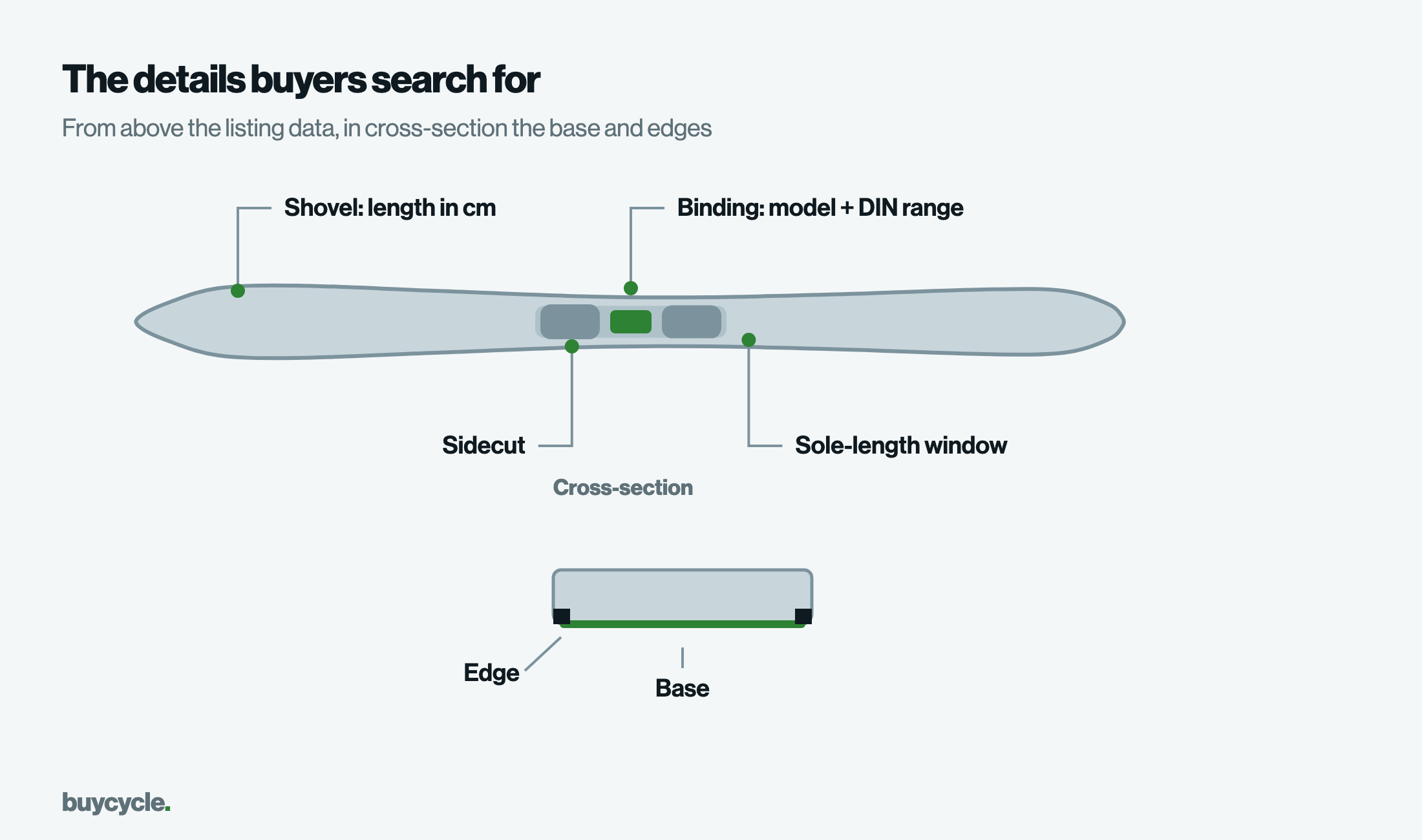
The length is usually printed on the tip or at the waist. Model name and year are on the topsheet — if the graphics have faded, an image search for the design usually gets you there.
Radius and sidecut
The number sequence like "132-88-114" describes shovel, waist and tail in millimetres. The radius in metres is often printed next to it. Experienced buyers filter on both.
Binding: model and DIN range
The binding model is printed on the toe piece. The DIN adjustment range — something like "3–11" — decides which body weight the binding is suitable for at all.
The sole length it is set to
The most frequently forgotten and most frequently requested detail. It sits in a small window on the heel piece, in millimetres. It tells the buyer whether their boot fits without a workshop visit — and is often the difference between an enquiry and a purchase.
2. Check the condition honestly
Go through the skis systematically once. What you find belongs in the listing — not because it lowers the price, but because a buyer who discovers a problem themselves cancels the sale.
Base
Lay the skis base-up and look flat across the surface. Fine scratches are normal. Deep grooves running to the edge, or spots where the base has worn through, are worth mentioning.
Edges
Run a fingernail along the edge. Rust can be taken off. Chips and dents cannot — they are a legitimate reason for a price reduction, but not a reason to leave the skis unsold.
Delamination
Check at the tip and tail especially for layers separating. A visible gap is a serious defect and has to go in the listing.
Binding
Open and close the binding several times. It has to engage cleanly. Check that the screws are tight and the plate is not cracked.
The age of the binding
Manufacturers only keep bindings on their service lists for a limited time — after roughly ten years, workshops will no longer adjust them. If your binding is in that territory, write it down. It costs you less than you think: for many buyers, skis with an older binding are still interesting, as a second pair or for conversion. Left unsaid, it turns into a return.
3. Clean and service
What is worth doing and what is not:
Always worth it
- Take the rust off the edges. With an edge eraser or fine steel wool. Ten minutes of work, a visible difference in every photo.
- Clean the base. Strip off old wax residue, remove dirt. A clean base photographs far better.
- Clean the binding. Brush salt and grit out of the mechanisms.
- Wipe the topsheet. Remove sticker residue.
Usually not worth it
A full workshop service with base repair and an edge grind costs €40 to €60 depending on where you are. On a ski that fetches a median of €280, that is a noticeable share of the proceeds — and the buyer will usually have the skis tuned to their own style after buying anyway. The exception: high-end skis at the top of the price range, where a fresh service can be the difference between €400 and €500.
4. The seven photos your listing needs
Photograph in daylight, against a neutral background — a light wall or the garage floor is plenty. No snow in the frame, no clutter, no backlight.
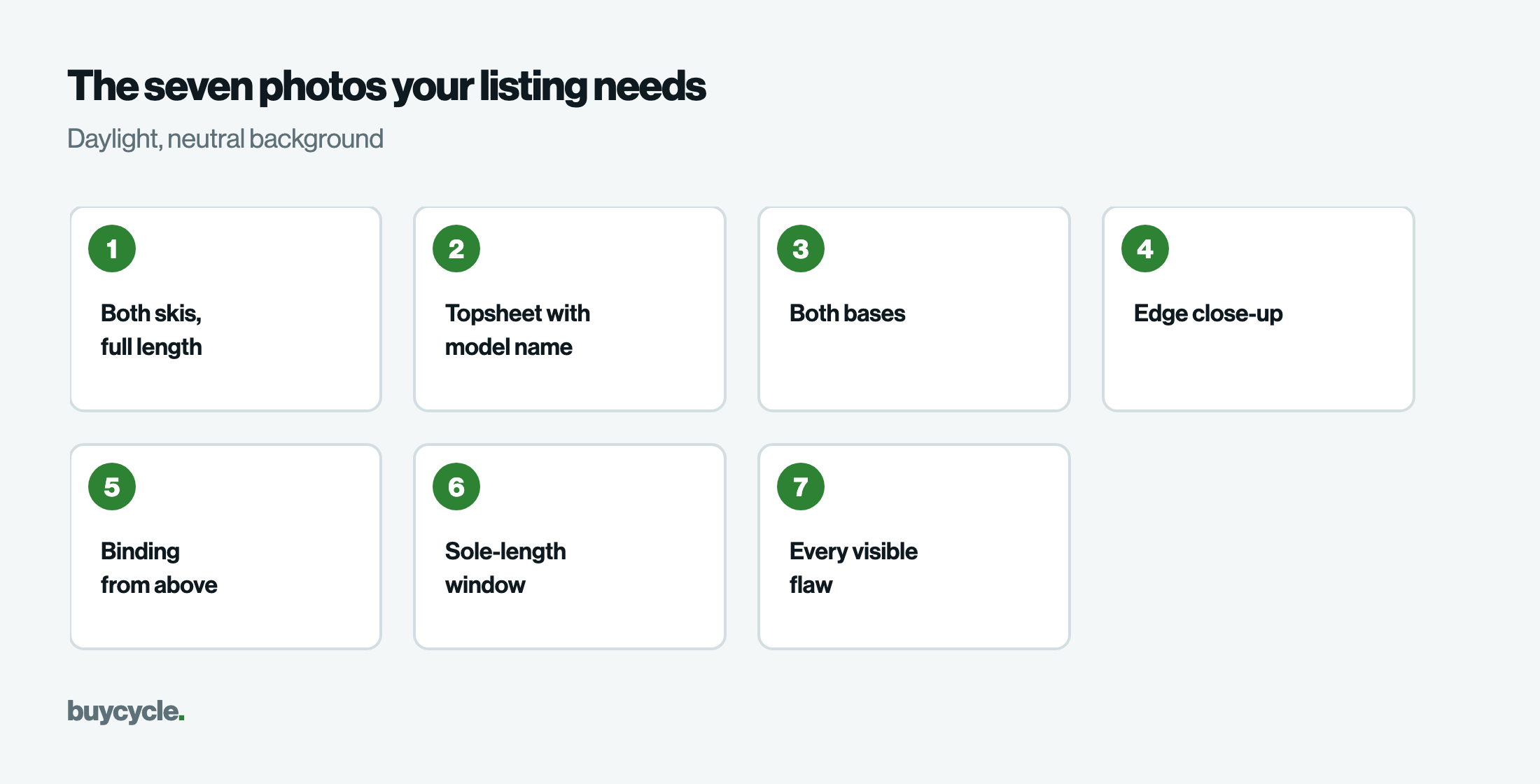
- Both skis at full length, lying side by side. The overview shot and your cover image.
- The topsheet design close up, so the model name and graphics are legible.
- Both bases at full length. Shows the real condition more honestly than any description.
- One edge in detail, photographed flat.
- The binding from above, with toe and heel units in frame.
- The sole-length window close up, so the number is readable.
- Every relevant flaw — photographed deliberately, not hidden.
The last image is the most important. A visibly documented scratch reads as confident; the same scratch, discovered by the buyer on unpacking, reads as deception.
5. Writing the description
Three short paragraphs are enough:
What it is. Model, year, length, binding with DIN range and the sole length it is set to.
How it was used. Roughly how many ski days, what terrain, whether it was serviced regularly. "Around 30 ski days, mostly piste, serviced once a season" says more than "very good condition".
What is not perfect. The flaws from step 2, stated plainly. That is not a drawback in a listing — it is the reason somebody buys without asking questions first.
6. Do not forget boots and poles
Anyone fetching skis out of the basement usually has boots and poles down there too. Both sell separately — ski and touring boots achieve a median of €180.
Ski boots
The decisive detail is the Mondopoint size, not the EU size. It is usually printed on the shell or inside the liner, and it is the number buyers search for. Add the flex index and the sole length in millimetres — the latter being the same figure needed for binding adjustment.
Before photographing: take the liners out, let them air, and put everything back together dry. Check that all buckles are present and working — a missing buckle is a common reason for a price reduction and is often cheap to replace.
Be honest about the soles. Worn-down soles at heel and toe are a safety matter, because the binding will no longer release reliably. If yours are noticeably worn there, it belongs in the listing.
Poles
Poles are quick: state the length in centimetres, check the baskets are complete, wipe the grips and straps. Bent shafts should be mentioned. On their own poles bring in little — but as an addition to a ski set they make the offer more attractive.
What you can skip
Three things that regularly do not pay off before a sale:
- New bases or major repairs. Put €80 into a base repair and you rarely get it back on resale. Better: document the damage and adjust the price.
- A fresh wax. Invisible in photos, and the buyer will have the skis tuned to their own style anyway.
- New stickers or touch-up paint. It quickly looks like an attempt to cover something up, and does more harm than good.
Conclusion
The preparation costs you a good hour: collect the details, check the condition, take the rust off the edges, seven photos, three paragraphs. In return you are working in a range where roughly €90 separates the condition grades — and you spare yourself the questions an incomplete listing inevitably triggers.
What your gear is actually worth is in the price guide for used skis. The whole process from listing to payout is in the complete guide to selling skis.
Frequently asked questions
Do I need to have my skis serviced before selling?
In most cases no. A workshop service costs €40 to €60 and is mainly worth it for high-end skis at the top of the price range. Taking the rust off the edges and cleaning the base you can do yourself — visually that achieves almost the same effect.
How old can a ski binding be?
Manufacturers keep bindings on their service lists for around ten years. After that, workshops refuse to adjust them. You can still sell such skis — you just need to note it clearly in the listing.
How do I remove rust from the edges?
With an edge eraser from a sports shop or with fine steel wool. Work lengthways, not across. For heavy rust, a workshop can take on the edge grind.
How many photos does my listing need?
Seven well-chosen images cover everything a buyer wants to see: the overview, the topsheet, both bases, one edge, the binding and the sole-length window — plus every visible flaw.