How to sell your snowboard: the complete guide

The short version
- Snowboards are the fastest category in winter sports: a median of 17 days to sell, noticeably quicker than skis.
- The median price is €250, with the middle 50% of sales between €138 and €395.
- Snowboards hold their value better than skis.
- Selling is free — no commission, no listing fee, and the buyer pays the shipping.
In selling guides, snowboarders are usually the paragraph at the end that starts "the same broadly applies to boards". Not this one — for a simple reason: boards are the category that performs best on buycycle.
The good news first
Over the 2025/26 season, snowboards sold in a median of 17 days. Skis took 23, ski jackets 36. Boards also hold on to a larger share of their retail price than skis do.
The reason is straightforward: the second-hand market for boards is smaller and more specialised. Someone looking for a particular board is really looking for it — and rarely finds it in the sports shop round the corner.
| Category | Median price | Typical range | Days to sell |
|---|---|---|---|
| Snowboards & splitboards | €250 | €138 – 395 | 17 |
| Skis (alpine & touring) | €280 | €200 – 400 | 23 |
Why sell your snowboard on buycycle
Selling costs you nothing
No commission, no listing fee. The agreed price goes to you in full — unlike consignment at a sports retailer, where depending on the shop about a third of the proceeds stays behind.
The buyer pays the shipping
You pack the board, the buyer covers the transport costs.
Payment is secured
The money is held before you hand over the parcel.
Buyers across Europe
A 156 cm freestyle board may find no taker locally — across Europe it will.
1. What is my snowboard worth?
The median price is €250. The middle 50% of all sales fall between €138 and €395 — the spread comes mostly down to condition and age.
As a starting point, take around a third of the original retail price and adjust up or down. A two-year-old board in very good condition sits well above that; an eight-year-old one with visible base damage, below.
The detailed method is in the price guide for used winter gear.
2. Where you can sell your board
Classifieds are free but local — and for boards the nearby audience is thin. A retailer trade-in is quick but sits well below market value and often ends in a voucher rather than cash. With consignment, a substantial part of the proceeds stays with the shop.
A specialised platform costs you nothing and reaches exactly the buyers searching for your model.
3. Preparing the board
Base and edges
Clean the base, strip off old wax residue, take the rust off the edges with an edge eraser. Deep scratches and chips belong in the listing — named honestly they cost you less than discovered on unpacking.
Photograph the inserts — the most important step
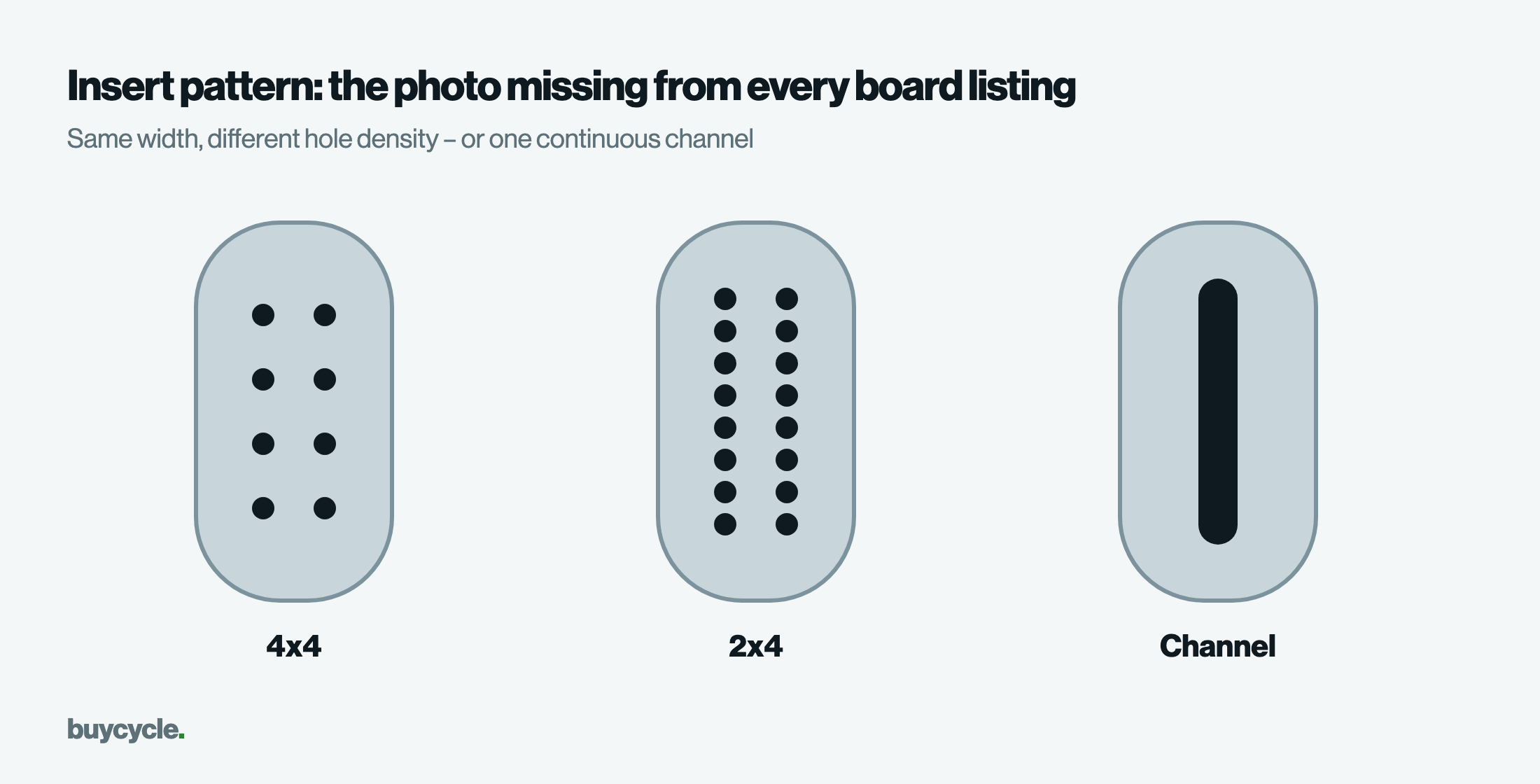
This is the detail that decides the sale on boards and is missing from almost every listing. Unscrew the binding and photograph the exposed insert pattern.
The reason: not every binding fits every board. Between the classic 4x4 pattern, the 2x4 grid and Burton's Channel system there are real compatibility limits. A buyer wanting to reuse their existing binding has to see the pattern. If it is not in the listing, you get either a question — or nothing.
4. Bindings and boots: together or separately?
Binding: selling it with the board usually makes sense. A ready-to-ride set is attractive for beginners, and the compatibility problem disappears.
Boots: list them separately. Snowboard boots are purely a fit decision — the chance that someone is looking for exactly your board and exactly your shoe size is small. Separately you reach two audiences instead of one.
Be realistic about used boots: they achieve noticeably lower prices than boards, because the liner packs out over the years. That does not mean throwing them away — well-kept boots find buyers reliably, just not at board prices.
5. The details board buyers search for
Snowboard buyers filter differently from ski buyers. Alongside length and waist width, two details above all decide whether your listing gets found.
The intended use
Freestyle, all-mountain, freeride or powder — that is the first selection a buyer makes. If you are unsure: all-mountain boards are roughly as wide in the middle as at the ends and mostly symmetrical, powder boards taper noticeably towards the tail. If the intended use is not in the listing, the buyer has to guess — and most do not, they click on.
Camber or rocker
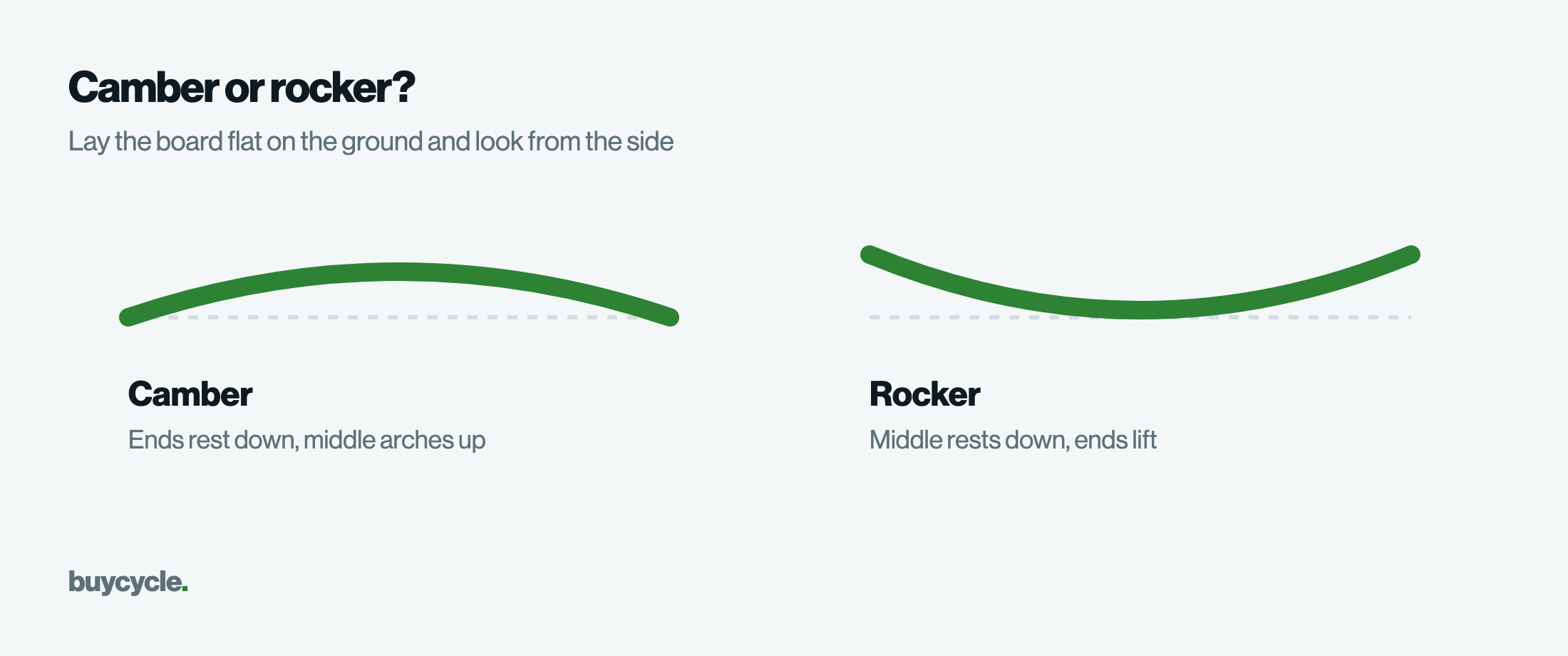
Lay the board base-down on a flat floor and look at it from the side. Does it touch in the middle and lift at the ends? That is a rocker. Does it rest at the ends and arch up in the middle? That is a camber. Many modern boards mix both.
This detail costs you thirty seconds and answers one of the most common follow-up questions in advance.
The weight range
If you still know it or can find it on the board: the recommended weight range helps buyers judge whether the length suits them. Beginners in particular lean on it heavily.
6. Splitboards: small but valuable
Splitboards are their own league. Volumes on the second-hand market are small, prices correspondingly stable, and buyers know exactly what they are looking for.
If you are selling a splitboard, these details absolutely belong in the listing: the interface system, whether skins are included and what condition they are in, and the condition and completeness of the crampons. Skins are a wear item — their condition affects the price noticeably.
A note on safety equipment: avalanche transceivers, probes and shovels do not belong in the parcel if you are unsure of their history. A used transceiver with no known service record is a real risk for the buyer — and no meaningful extra income for you.
Conclusion
Snowboards are the winter category that sells fastest and holds value best. €250 at the median, 17 days to sell — and since selling costs nothing and the buyer pays the shipping, the proceeds stay with you in full.
If you take one thing from this guide: unscrew the binding and photograph the inserts.
When to list your board is shown by our data check on the best time to sell — and if you have skis to move on as well, the process is in the complete guide to selling skis.
Frequently asked questions
What is my used snowboard worth?
A median of €250, with the middle 50% of all sales falling between €138 and €395. As a rule of thumb, a well-kept board achieves around a third of its original retail price.
Should I sell board and binding together?
Usually yes — a ready-to-ride set is especially attractive to beginners, and compatibility questions fall away. Boots, on the other hand, are better sold separately, because they are purely a fit decision.
How do I pack a snowboard for shipping?
In a flat, long box — sports shops will usually hand one over free. Pad the nose and tail additionally, cover the edges with cardboard so they cannot cut through the packaging. Either unscrew the binding and pack it separately or secure it with bubble wrap.
Is it worth selling old snowboard boots?
Yes, provided the liner still gives support and the sole is not worn through. Prices sit well below those of boards, but well-kept boots find buyers reliably — especially in common sizes.
How do I identify my board's insert pattern?
Unscrew the binding. What appears is either a grid of individual threaded inserts — the classic 4x4 or the tighter 2x4 pattern — or one continuous longitudinal slot, the Channel system. A photo of it belongs in every listing.