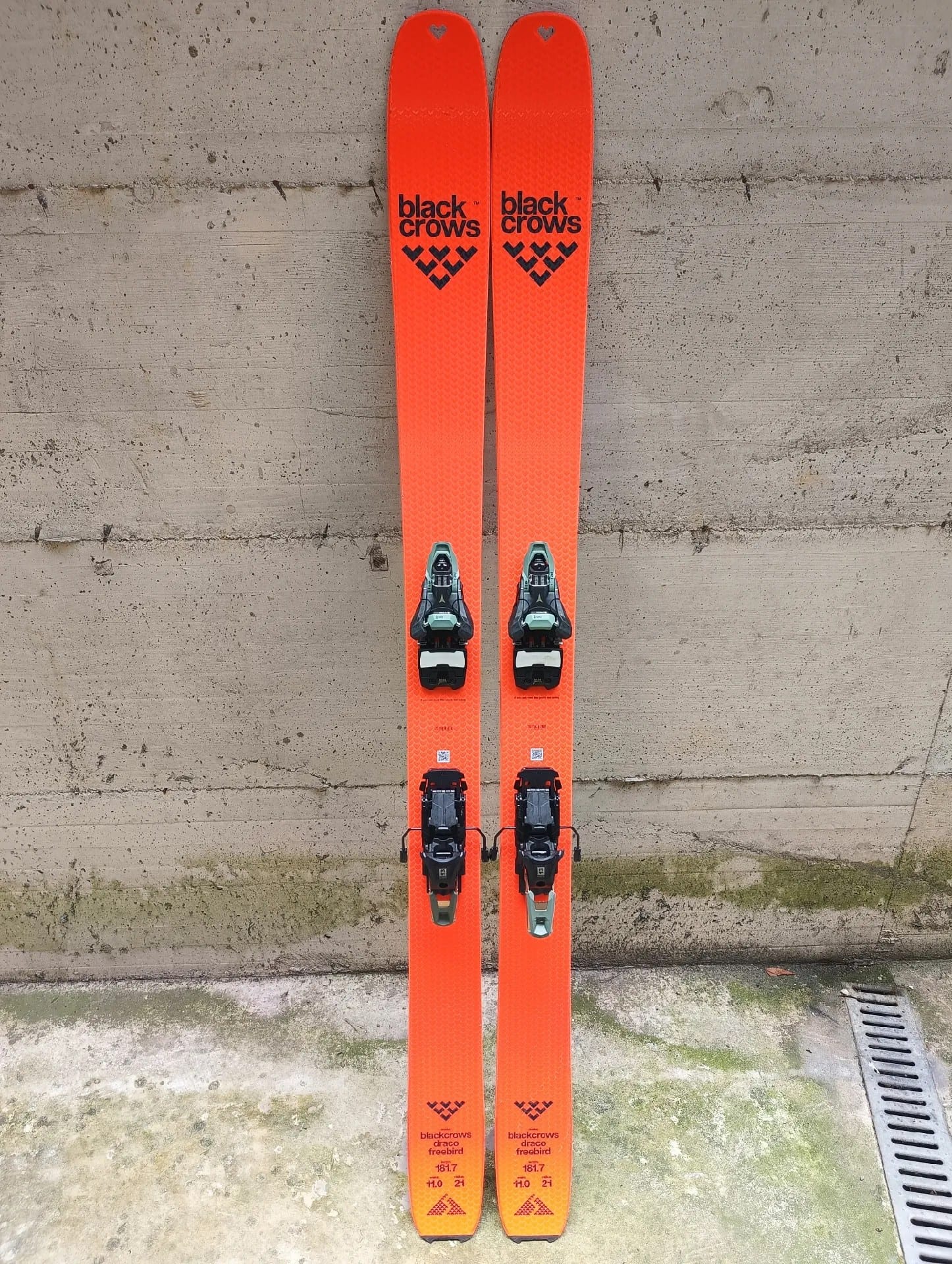
For a modern piste or all-round ski: beginners choose their height minus 10 to 15 cm, intermediates minus 5 to 10 cm, very good skiers minus 5 to 0 cm. At a height of 175 cm that means 160–165 cm, 165–170 cm and 170–175 cm. Weight, ski type and rocker shift the result by about one size step (5 cm). And because skis are built in steps of 5–8 cm, it is best to look for a range rather than an exact number: in the 160–174 cm range there are over 3,000 used skis on buycycle.
As of: 2026/27 season, 3 November 2026. Used-ski data: analysis of over 7,600 alpine and touring ski listings with a stated length on buycycle. All lengths are guidelines, not a guarantee.
Ski length chart: height × ability
This is our chart for piste and all-round skis (carvers). Find your height, then your ability, and read off the range in cm.
| Height | Beginner (−15 to −10 cm) | Intermediate (−10 to −5 cm) | Expert (−5 to 0 cm) |
|---|---|---|---|
| 150 cm | 135–140 cm | 140–145 cm | 145–150 cm |
| 155 cm | 140–145 cm | 145–150 cm | 150–155 cm |
| 160 cm | 145–150 cm | 150–155 cm | 155–160 cm |
| 165 cm | 150–155 cm | 155–160 cm | 160–165 cm |
| 170 cm | 155–160 cm | 160–165 cm | 165–170 cm |
| 175 cm | 160–165 cm | 165–170 cm | 170–175 cm |
| 180 cm | 165–170 cm | 170–175 cm | 175–180 cm |
| 185 cm | 170–175 cm | 175–180 cm | 180–185 cm |
| 190 cm | 175–180 cm | 180–185 cm | 185–190 cm |
| 195 cm | 180–185 cm | 185–190 cm | 190–195 cm |
Applies to adults, women and men alike. For all-mountain, freeride and race skis the values shift, see below. Children have their own rules.
Which type of skier are you? Most sites leave "intermediate" undefined. We follow Stöckli's classification:
- Beginner: You ski occasionally. Turns and stops work, but you are still cautious.
- Intermediate: You like blue and red runs and make parallel turns at moderate speed.
- Expert: You also ski black runs, are used to high speed and difficult conditions, and are working on your technique.
If in doubt, take the lower level. A ski that is too short is more forgiving than one that is too long.
What ski length at 160, 165, 170, 175, 180 and 185 cm height?
The figures come from the chart above. Next to them, the number of used alpine and touring skis listed on buycycle since launch in the range from your height minus 15 cm up to your height (5 cm steps, as of 3 November 2026).
What ski length at 160 cm?
Beginners ski 145–150 cm, intermediates 150–155 cm, experts 155–160 cm. There were 1,702 listings in the 145–159 cm range.
What ski length at 165 cm?
Beginners ski 150–155 cm, intermediates 155–160 cm, experts 160–165 cm. There were 2,582 listings in the 150–164 cm range.
What ski length at 170 cm?
Beginners ski 155–160 cm, intermediates 160–165 cm, experts 165–170 cm. There were 2,896 listings in the 155–169 cm range.
What ski length at 175 cm?
Beginners ski 160–165 cm, intermediates 165–170 cm, experts 170–175 cm. There were 3,286 listings in the 160–174 cm range, more than for any other height.
What ski length at 180 cm?
Beginners ski 165–170 cm, intermediates 170–175 cm, experts 175–180 cm. There were 3,112 listings in the 165–179 cm range.
What ski length at 185 cm?
Beginners ski 170–175 cm, intermediates 175–180 cm, experts 180–185 cm. There were 2,872 listings in the 170–184 cm range.
The 4 factors: what determines ski length besides your height
Height is only the starting value. Ability, weight, skiing style and ski type each shift the length by about 5 cm.
Height
A rule of thumb for on the go: the ski tip reaches about chin height for beginners, nose or eye level for intermediates and the top of the head for experts. You measure without shoes. The rule of thumb gives roughly the same numbers as the chart.
Skiing ability
Shorter skis turn more easily and forgive mistakes. Longer skis run more smoothly at speed and float better in deep snow. That is why skis get longer as your ability grows.
Weight
Heavier than usual for your height: upper half of the range or one size longer. Lighter: lower half or one size shorter. As a rough benchmark for "usual" we take height in cm minus 100 in kg (175 cm: 75 kg). If you are about 10 kg or more above that, choose the upper end; if you are about 10 kg or more below, the lower end. This is our rule of thumb, not a manufacturer standard.
Skiing style
Short, tight turns and speed control: rather shorter. Long, wide turns at high speed or lots of off-piste terrain: rather longer.
Ski length by ski type: slalom, piste, all-mountain, freeride
The wider and more terrain-oriented the ski, the longer you ski it. Race skis for tight turns are the shortest. The values are deductions (−) or additions (+) to your height.
| Ski type | Beginner / intermediate | Expert |
|---|---|---|
| Slalom, short-turn carver | −15 to −10 cm | −15 to −10 cm |
| Giant slalom / race | −15 to −5 cm | −5 to 0 cm |
| Piste / all-round (carver) | −15 to −5 cm (see chart) | −5 to 0 cm |
| All-mountain (approx. 75–90 mm waist width) | −10 to −5 cm | −5 to 0 cm |
| Freeride (from approx. 95 mm) | −5 to 0 cm | 0 to +10 cm |
| Freestyle / park | about −10 to 0 cm | about −10 to 0 cm |
| Touring | −10 to −5 cm | −5 to 0 cm (up to +5 if downhill-oriented) |
| Cross-country | different rules | different rules |
Sources for the ranges: Stöckli (model-specific recommendations), INTERSPORT Rent, Gigasport, SnowTrex. The freestyle values are guidelines without a reliable manufacturer figure. Cross-country skis are skied much longer, which is a topic of its own.
On buycycle there is a matching category for every type: Stöckli piste and all-round skis (Laser), Völkl Racetiger for racers, Völkl Mantra and Nordica Enforcer for all-mountain to freeride and touring skis for ski touring.
Why length alone is not enough: rocker, radius, size steps
Rocker makes the ski shorter than it looks: the more rocker, the less edge is in the snow. That is why you tend to choose the longer version for a ski with a lot of rocker. Nordica explicitly recommends this in its ski sizer for models with rocker. There is no fixed number of centimetres for it; if in doubt, take the next size up.
Then there is the radius: a ski with a small radius (slalom) turns tightly and is skied short, one with a large radius (giant slalom) needs length for a stable ride.
Skis only come in fixed sizes. Blizzard, for example, builds a touring ski in 157, 164, 171, 178 and 185 cm, so in 7 cm steps, and a junior ski in 8 cm steps. The steps are clearly visible in the listings on buycycle. The most common lengths are 170 cm (558 listings), 160 cm (400), 163 cm (355), 165 cm (319), 156 cm (269), 175 cm (268) and 177 cm (257). If you search for exactly 168 cm, you only find 236 pairs; at 170 cm there are more than twice as many.
Between two sizes?
- Shorter: if you are a beginner or light, mostly ski on piste, like short turns or haven't been on skis for a long time.
- Longer: if you are heavy or athletic, ski fast, spend a lot of time off-piste or the ski has a lot of rocker.
Is there a difference between women's and men's skis?
Length depends on height, weight and ability, not on gender. The sources disagree here: INTERSPORT Rent and Gigasport write that women should ski shorter skis. But INTERSPORT Rent's women's chart has the same values as its men's chart for the same height, so the text and the numbers contradict each other.
We handle it like this: the same chart applies. Women are on average lighter and put less weight on the ski, so they more often end up in the lower part of their range. Women's models are also often built lighter and softer and are offered in shorter length ranges (Gigasport). That is a difference in construction, not a different length measure.
Too short or too long? How to tell on the slopes
A ski that is too short gets unstable at speed, one that is too long is hard to turn.
| Symptom | Probably too short | Probably too long |
|---|---|---|
| Speed | Ski chatters, gets unstable | Ski feels sluggish, hard to control |
| Turns | Little stability in long, wide turns | Hard to initiate, you have to use a lot of force |
| Hard snow | Less stability and edge grip | Ski pushes instead of carving |
| Deep snow | Little float, tip dives | A lot of float |
| Body | You feel unsure at speed | You lean back and tire quickly |
The symptoms are based on the disadvantage lists from INTERSPORT Rent and SnowTrex, supplemented by practical experience. They are a guide, not a substitute for a test ride.
If you notice that your ski no longer fits: Selling skis on buycycle: how it works →
Ski length when buying used: what to look out for
One length is not enough when you buy used. Check the stated length, search a range and look at age and binding.
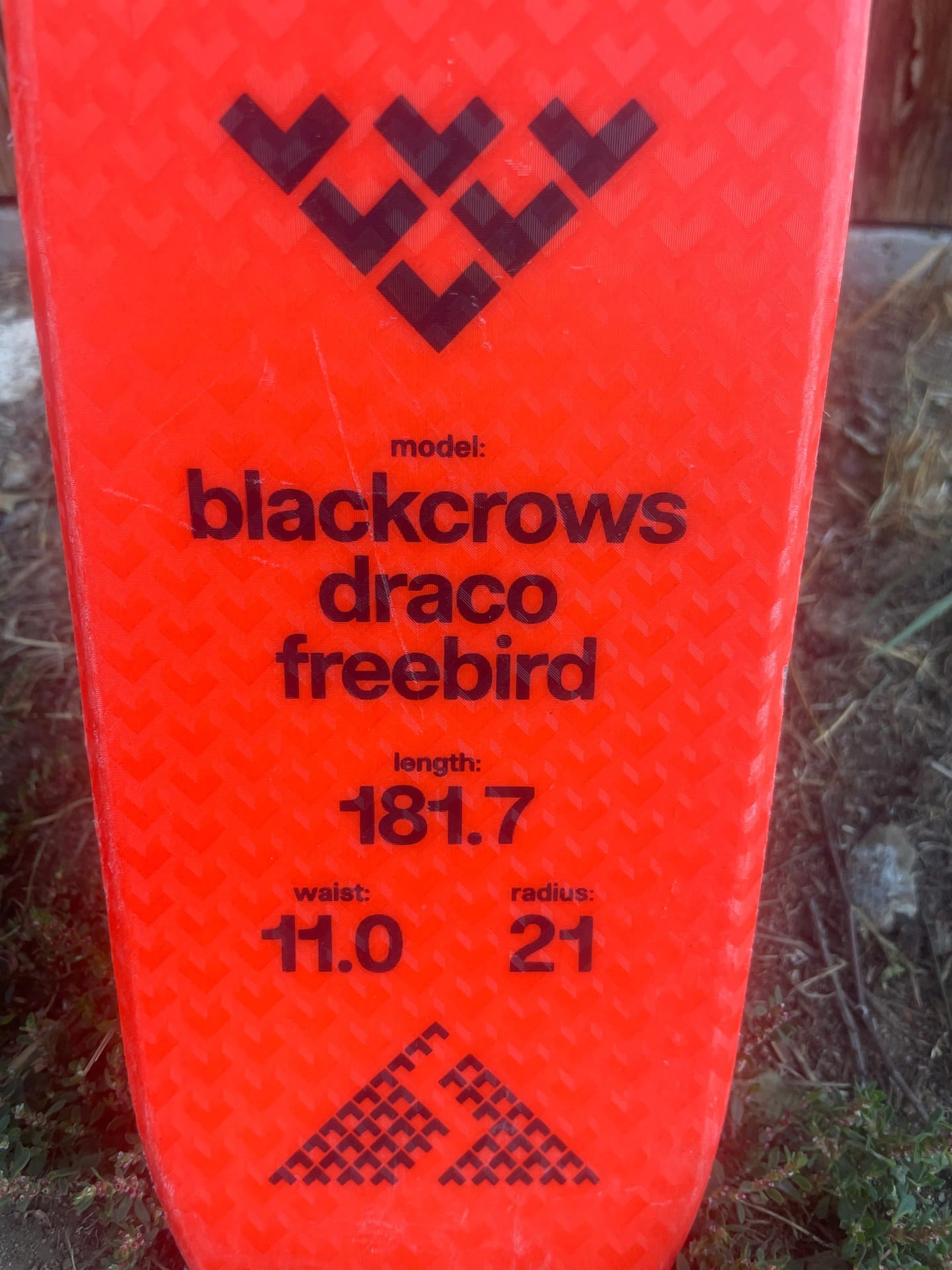
- Check the length in the listing. The length is usually printed on the base or the side edge, often at the ski tail as well. Ask the seller for a photo of it. Some manufacturers also print the measured length with a decimal place on the base (photo above). A quick check with a tape measure along the base can help if you have doubts.
- A range instead of a target size. Each ability level covers about 5 cm. If you are an intermediate at 175 cm, 165–170 cm are an option, and with weight and rocker also 162 to 172 cm. A single step (170–174 cm) had 1,153 listings, the 165–179 cm range 3,112, which is 2.7 times as many. Save a search so you don't miss new listings.
- Don't measure old skis by new rules. Before waisted carving skis, experienced skiers used skis of their height plus 5 to 10 cm and beginners minus 5 to 10 cm (Gigasport). A 190 cm ski from that era is not comparable to a modern 175 cm carver. The chart above does not apply to skis from before the carving boom.
- Ex-rental skis are often beginner lengths. Rental skis are mostly designed for beginners and all-rounders: good for learning, often too short for experts.
- Binding and boot. Length is independent of the binding. But the binding must match the boot sole length and be adjusted by a specialist workshop and tested to ISO 11088 (currently DIN ISO 11088:2023-08). You can also find matching bindings and ski boots used. Some workshops refuse older bindings. Ask before you buy.
Lengths and prices of used skis on buycycle
Used skis in the middle of the length range cost about €290–300, whether 165 or 185 cm long. Mostly skis between 160 and 189 cm are sold. Sorted by length, the listings show a clear picture in volume, while selling prices barely differ.
| Length | Listings | Typical asking price | Sold | Typical selling price |
|---|---|---|---|---|
| under 150 cm | 740 | €161 | 6 | – |
| 150–159 cm | 1,358 | €230 | 24 | €255 |
| 160–169 cm | 2,133 | €265 | 85 | €300 |
| 170–179 cm | 2,203 | €300 | 137 | €290 |
| 180–189 cm | 1,036 | €350 | 96 | €285 |
| 190 cm and up | 160 | €300 | 10 | – |
Methodology: alpine and touring skis, all net listings from private and commercial sellers since launch in July 2025, including sold and inactive ones; 7,630 listings with a stated length from 131 to 210 cm (children's skis excluded). Asking price = median listing price, selling price = median of the skis actually sold. For lengths with fewer than about 20 sales we show no selling price. As of 3 November 2026.
Three things stand out:
- Sellers ask more, buyers don't pay more. The asking price rises with length (from €230 at 150–159 cm to €350 at 180–189 cm). But the actual selling prices between 160 and 189 cm are all around €285–300. Long skis are not automatically more expensive, just more often priced higher.
- The middle is well stocked, the edges are thin. From 185 cm there are only just over 500 listings, from 190 cm 160. If you are very tall, you have less choice and should save a search. Below 150 cm the selection is smaller too.
- The types differ in length. The typical all-mountain ski is 163 cm long (4,687 listings, 80% of them between 149 and 179 cm), freeride/powder 171 cm (666 listings, 80% between 153 and 186 cm), touring skis 171 cm (254 listings, 155–184 cm) and park/freestyle 165 cm (112 listings). That fits the chart: freeride and touring skis are longer than the all-round ski.
• Length: range from the chart, then factor in weight, type and rocker.
• Check: length in the photo, binding to boot sole length, edges and base.
• Price: what a used ski is worth is explained in our price guide for used skis.
Why ski length charts contradict each other
The charts start from different assumptions: other ski types, other target groups and a different ski age. A few examples and which rule we use:
- Beginners: −10, −15 or −20? SnowTrex gives −20 to −10, INTERSPORT Rent −10 (piste), Gigasport and Stöckli −10 to −15. We use −15 to −10: with −20 you give away stability even at moderate speed.
- Experts: 0, −5 or +10? SnowTrex advises pros up to +10, Gigasport +5 to +15, INTERSPORT Rent for piste −5, Stöckli −7 to 0. The high values come from the time before carving or apply to race and freeride skis. For the modern piste and all-round ski we use −5 to 0.
- Giant slalom: your height or +15? Stöckli: up to your height for good skiers, Gigasport +5 to +15 for race pros. For recreational skiers we use −5 to 0.
- Slalom: −15 or −20? Stöckli uses −15 at every level for slalom models. We stay with −15 to −10.
- Providers mix types. Some sites give one number for "skis" and mean the race ski one time, the rental ski the next.
The ranges are smaller than they look: almost all rules fall within one size step (5 cm). You decide the choice within that range through weight, style and rocker.
FAQ
What ski length fits which height?
For a modern piste ski: height minus 10 to 15 cm (beginners), minus 5 to 10 cm (intermediates), minus 5 to 0 cm (experts). You will find the complete chart for 150–195 cm above.
How do I find the right ski length?
Take your height without shoes, find your ability in the chart and adjust by about 5 cm for weight, skiing style, ski type and rocker. If you are between two sizes, ability and weight decide.
What ski length is ideal?
The one that suits your ability and use. As a guideline, the ski reaches from the chin (beginners) via the nose (intermediates) to just below the top of the head (experts).
What ski length at a height of 175 cm?
160–165 cm as a beginner, 165–170 cm as an intermediate, 170–175 cm as an expert.
What ski length at 165 cm?
150–155 cm as a beginner, 155–160 cm as an intermediate, 160–165 cm as an expert.
What ski length at 180 cm?
165–170 cm as a beginner, 170–175 cm as an intermediate, 175–180 cm as an expert.
What ski length for which age?
For adults it is not age that counts but height, weight and ability. For children a rule of thumb applies from chest to nose, according to Stöckli 20 to 30 cm shorter than their height. There is no children's chart here.
What ski length for teenagers?
Teenagers who have stopped growing use the adult chart and tend to choose the lower end. Growing teenagers are better off staying shorter, because the ski is easier to handle and they outgrow it faster.
Measure with or without ski boots?
Without. For height, your height in socks counts. The boots only matter for the binding (sole length).
Is a ski that is too short or too long worse?
For beginners a ski that is too long is the bigger problem because it is hard to turn. Too short is less stable at speed but easier to ski. If in doubt, take the shorter one.
Sources: INTERSPORT Rent, "Die richtige Skilänge finden" (updated 12.10.2026); Stöckli, ski length recommendation; SnowTrex, "Die richtige Skilänge finden" (updated 07.08.2026); Gigasport, "Welche Skilänge passt zu mir?" (13.03.2025); Nordica and Blizzard, ski sizers (manufacturer information on rocker and size steps); DIN ISO 11088:2023-08 (ski binding). Used-ski data: analysis of alpine and touring ski listings on buycycle (private and commercial), as of 3 November 2026.