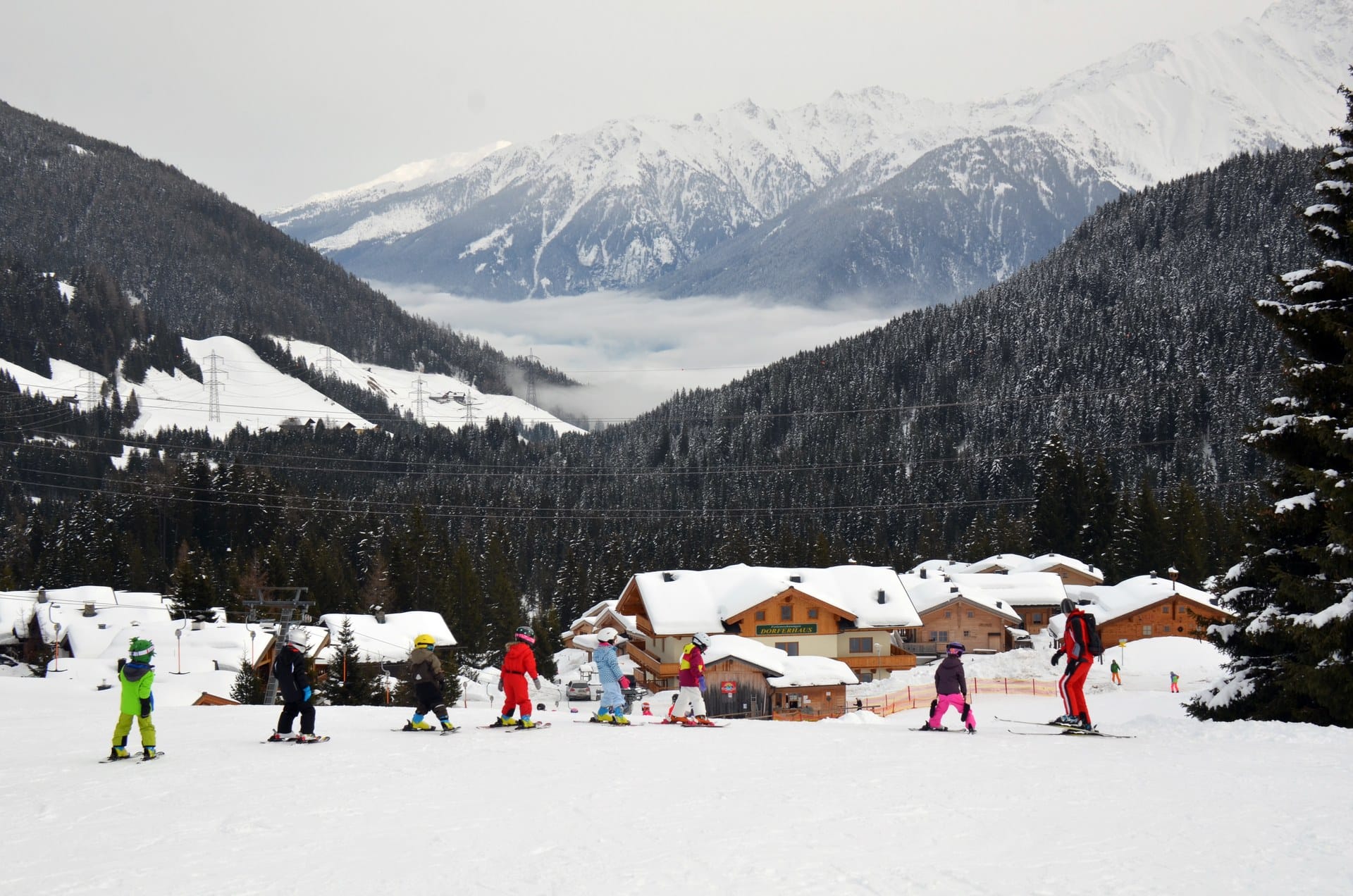
For beginners, kids' skis should reach about chest height (body height minus 30 to 40 cm), for confident skiers chin or nose height (minus 15 to 20 cm), for sporty kids eye level (minus 5 to 10 cm). Below about 110 cm body height, the shortest available length (60 to 70 cm) usually decides; from about 160 cm and 55 kg, adult skis fit. You don't have to buy new: used kids' skis typically cost €60 to 75 on buycycle, and after one or two winters you can sell them again.
As of: November 2026, 2026/27 season. Used prices: analysis of more than 650 kids' ski listings on buycycle (private and commercial sellers).
Kids' ski length at a glance: the 4 rules
- Body height and ability determine the length. Age is only a rough guide, because children of the same age can differ by 15 cm or more.
- When in doubt, weight decides. If your child is light or slim for their height, take the lower end of the range; for sturdy kids, the upper end.
- Shorter is easier to turn, longer runs more smoothly. That's why beginners are better off with shorter skis.
- From about 160 cm and 55 kg, most children switch to adult skis.
These are guide values, not a guarantee. When in doubt, choose the shorter length for beginners.
Kids' ski size chart: length by body height and ability
The chart converts the retailers' rules of thumb into centimetres: beginners body height minus 30 to 40 cm, intermediates minus 15 to 20 cm, sporty skiers minus 5 to 10 cm. Kids' skis usually come in steps of about 10 cm (for example 97, 107 and 117 cm), so choose the closest length.
| Body height | Beginner (chest) | Intermediate (chin to nose) | Sporty (up to eye level) |
|---|---|---|---|
| 90 cm | 70 cm (minimum) | 70–75 cm | – |
| 100 cm | 70 cm (minimum) | 80–85 cm | 90–95 cm |
| 110 cm | 70–80 cm | 90–95 cm | 100–105 cm |
| 120 cm | 80–90 cm | 100–105 cm | 110–115 cm |
| 130 cm | 90–100 cm | 110–115 cm | 120–125 cm |
| 140 cm | 100–110 cm | 120–125 cm | 130–135 cm |
| 150 cm | 110–120 cm | 130–135 cm | 140–145 cm |
| 160 cm | 120–130 cm | 140–145 cm | 150–155 cm |
Our own conversion of the rules of thumb from INTERSPORT Rent and SkatePro (body height minus 40/35/30 cm for beginners, minus 15 cm for intermediates, minus 5 cm for pros); starting values rounded to 5 cm. For small children, the shortest available length sets the minimum (Intersport gives 60 cm as the lower limit for kids' skis, many models start at 70 cm).


Why do the charts online contradict each other?
Because two rules get mixed up. A well-known retailer site gives "body height minus 40 cm" for beginners and at the same time shows an age chart with much longer skis: a 3-year-old at 94 cm would get 54 cm by the first rule, but the age chart recommends 70 to 80 cm. The age chart corresponds roughly to "minus 10 to 25 cm", that is an average, already confident skier. The beginner rule is the stricter one.
The experts don't fully agree either:
- The German Ski Association (DSV aktiv) recommends skis between armpit and shoulder height for beginners, between neck and mouth for intermediates, and at least eye level but at most 5 cm above body height for sporty skiers.
- INTERSPORT Austria gives chest height as the minimum length for children under 115 cm, and at most forehead height for sporty children.
- Strongly shaped (sidecut) kids' carving skis should be chosen about 5 cm longer, according to the DSV. At 90 cm length they often have a radius of only 6 to 7 m, can almost only be skied on the edge and are hard to control on slick patches. This contradicts the rule "shorter is always easier", but applies mainly to models with a very small radius.
Our suggestion: use the chart above as a corridor, choose the lower end for beginners when in doubt, and the upper end for a very strongly shaped ski.
Kids' ski length by age (3 to 14 years)
A 3-year-old usually skis on 70 to 80 cm, a 6-year-old on 100 to 110 cm, a 10-year-old on 120 to 130 cm and a 14-year-old on 150 to 160 cm. Age is only a guide: the values for height and weight are averages and, according to INTERSPORT Rent, apply to about half of all children. When in doubt, go by body height.
| Age | Height (average) | Weight (average) | Ski length |
|---|---|---|---|
| 3 years | 94 cm | 14 kg | 70–80 cm |
| 4 years | 102 cm | 16 kg | 80–90 cm |
| 5 years | 109 cm | 18 kg | 90–100 cm |
| 6 years | 114 cm | 21 kg | 100–110 cm |
| 7 years | 122 cm | 23 kg | 100–110 cm |
| 8 years | 127 cm | 26 kg | 110–120 cm |
| 9 years | 135 cm | 29 kg | 120–130 cm |
| 10 years | 140 cm | 32 kg | 120–130 cm |
| 11 years | 145 cm | 36 kg | 130–140 cm |
| 12 years | 149 cm | 40 kg | 140–150 cm |
| 13 years | 156 cm | 45 kg | 140–150 cm |
| 14 years | 163 cm | 50 kg | 150–160 cm |
Source: INTERSPORT Rent (as of 12 Oct 2026). Several retailers use the same chart.
On the age to start: according to ekosport and INTERSPORT Austria, ski kindergartens often take children from 3 years and many ski schools from 4 years. In ski kindergarten the skis can easily be short, as they are more of a toy than sports equipment there. From about 7 to 8 years, technique matters more and with it the right length.
Kids' skis 70, 80, 90 … 150 cm: for which height and age?
A 90 cm kids' ski fits a child of about 4 to 5 years (around 100 to 110 cm tall), a 110 cm ski fits about 6 to 8 years (115 to 125 cm). The chart turns the question around: from length to height.
| Ski length | Typical age | Fits body height (intermediate) | Fits body height (sporty) |
|---|---|---|---|
| 70 cm | 2–4 years | 85–90 cm | – |
| 80 cm | 3–4 years | 95–100 cm | 85–90 cm |
| 90 cm | 4–5 years | 105–110 cm | 95–100 cm |
| 100 cm | 5–7 years | 115–120 cm | 105–110 cm |
| 110 cm | 6–8 years | 125–130 cm | 115–120 cm |
| 120 cm | 8–10 years | 135–140 cm | 125–130 cm |
| 130 cm | 9–11 years | 145–150 cm | 135–140 cm |
| 140 cm | 11–13 years | 155–160 cm | 145–150 cm |
| 150 cm | 12–14 years | from 160 cm (junior skis) | 155–160 cm |
Our own derivation from the age and height charts above. Beginners ski the same length from a much greater body height (body height minus 30 to 40 cm).
What ski length at 125 cm and at 140 cm body height?
At 125 cm it's 85 to 95 cm for beginners, 105 to 110 cm for intermediates and 115 to 120 cm for sporty children. At 140 cm it's 100 to 110 cm, 120 to 125 cm and 130 to 135 cm. According to the age chart, an average 8-year-old (127 cm) skis on 110 to 120 cm, an average 10-year-old (140 cm) on 120 to 130 cm.
Shorter or longer? When to deviate from the guide value
Choose shorter for light, cautious or unsure children, longer for heavy, fast and very good skiers. Specifically, INTERSPORT Rent says:
- Shorter ski if the child is slightly built, has never skied, skis very cautiously or likes making quick, short turns.
- Longer ski if the child is heavy for their height, already skis very well or likes to go fast.
- Plus about 5 cm for strongly shaped carving skis (DSV, see above).
Weight has a second effect: a child who is too light doesn't flex the ski and uses the edge poorly, one who is too heavy flattens it. That's why Intersport gives a limit of 55 kg, from which adult skis come into question.
Buying skis to grow into: is it worth it?
No, skis that are too long are one of the most common mistakes. None of the sources we read advises buying longer. INTERSPORT Rent calls skis that are too long an "absolute no-go": beginners find them harder, and the fun suffers. The DSV also gives only 5 cm above body height as the upper limit for sporty skiers, and not even that for beginners. The safest strategy is therefore: the upper end of your corridor from the chart, no more.
How long does a ski fit, then? Children in primary-school age grow about 5 to 6 cm per year (our own calculation from WHO median values for ages 6 to 10; the MSD Manuals give an average of just over 7 cm for ages 1 to 10; individual children differ a lot). The recommended ski length therefore grows by about 5 to 6 cm per year. In practice:
- A ski at the upper end of the corridor fits, by calculation, about 1 to 2 winters. INTERSPORT Rent gives a guide value for new skis: when the skis are more than 15 cm shorter than the recommended length, when skill has improved clearly, or when they are worn.
- The jump from beginner to intermediate is bigger than two years of growth. A beginner's 100 cm quickly becomes 115 cm for a confident skier. This is where it pays not to buy too early.
- Grow-with-me offers exist in retail. In 2024, INTERSPORT Austria offered two models with an exchange option: €15 on purchase, plus €25 when exchanging for a longer length within 2 years. This is an Austrian offer; check the current terms in the shop and whether similar offers exist where you live.
Buying used gets you exactly the same, only cheaper: in every size there are skis that a child has used for one or two winters.
Kids' skis: rent, buy new or buy used?
For one ski week a year, renting is the easiest. If you ski several weekends or have siblings, buying used and reselling later pays off. The table shows typical costs per child for skis, boots and poles (boots only where stated). The rental and retail prices come from shops in Germany and Austria: prices in other countries and resorts differ, so compare shops near your destination.
| Option | Cost | Included | Source |
|---|---|---|---|
| Weekly rental (6 days) | €50–70 | Skis, boots, poles; helmet +€11 | Ski-Schneider (€50), Sport Gross (€70), both Germany |
| Season rental | €130–270 plus approx. €15 service | Skis, boots, poles | Petzen, Austria (up to 140 cm: €130), Sport Gross, Germany (€149–269 depending on length and boot size) |
| New, starter set (skis + bindings) | around €100–180 | Skis and bindings, boots extra | Retailer pages Decathlon and McKinley, Germany (as of October 2026) |
| Grow-with-me exchange option (Intersport) | €15 on purchase + €25 on exchange | Larger pair within 2 years | INTERSPORT Austria, 2024 |
| Used on buycycle | typically €60–75 (skis, usually with bindings) | Skis, bindings; boots extra | our own analysis, see below |
Rental and new prices are retailer figures and vary by place and season.
On top of the purchase price, with used skis you should budget for the workshop check: the DSV expressly points out that buying second-hand adds costs for binding adjustment and service. As a guide, Sport Gross (Germany) gives €18 for a binding adjustment. With a purchase price of around €70 and a check, you're at about €90, roughly the cost of two rental weeks (German prices). If you sell the skis again at the end of the season, the net cost falls further.
And this is what the used market for kids' skis looks like on buycycle:
| Ski length | Listings | Typical price (median) | Middle 50% of prices | With bindings |
|---|---|---|---|---|
| up to 90 cm | 112 | €60 | €52–76 | 90 |
| 91–110 cm | 239 | €65 | €63–79 | 197 |
| 111–130 cm | 313 | €75 | €63–92 | 251 |
Analysis of 664 kids' ski listings (length 60–130 cm) on buycycle, private and commercial, all listings since launch including already sold ones. Price = listing price in €, median. As of: 3 November 2026. These are asking prices, not selling prices: too few kids' skis have been sold so far to give a typical selling price.
Where retailers stated a new price (59 listings), the listing price is around 60% of it. So you pay a fraction of the new price for skis that were mostly used for only one or two winters. We can't yet show how quickly they resell.
Found the right length? You'll find used kids' skis in that length in the ski category on buycycle, and after one or two winters you can sell them there again. How that works is in our guide to selling your skis. What a used pair is worth is shown in the price guide for used skis.
Used kids' skis: what to look for

- The length fits now, not later. Ask the seller for the length in cm and compare it with the chart above.
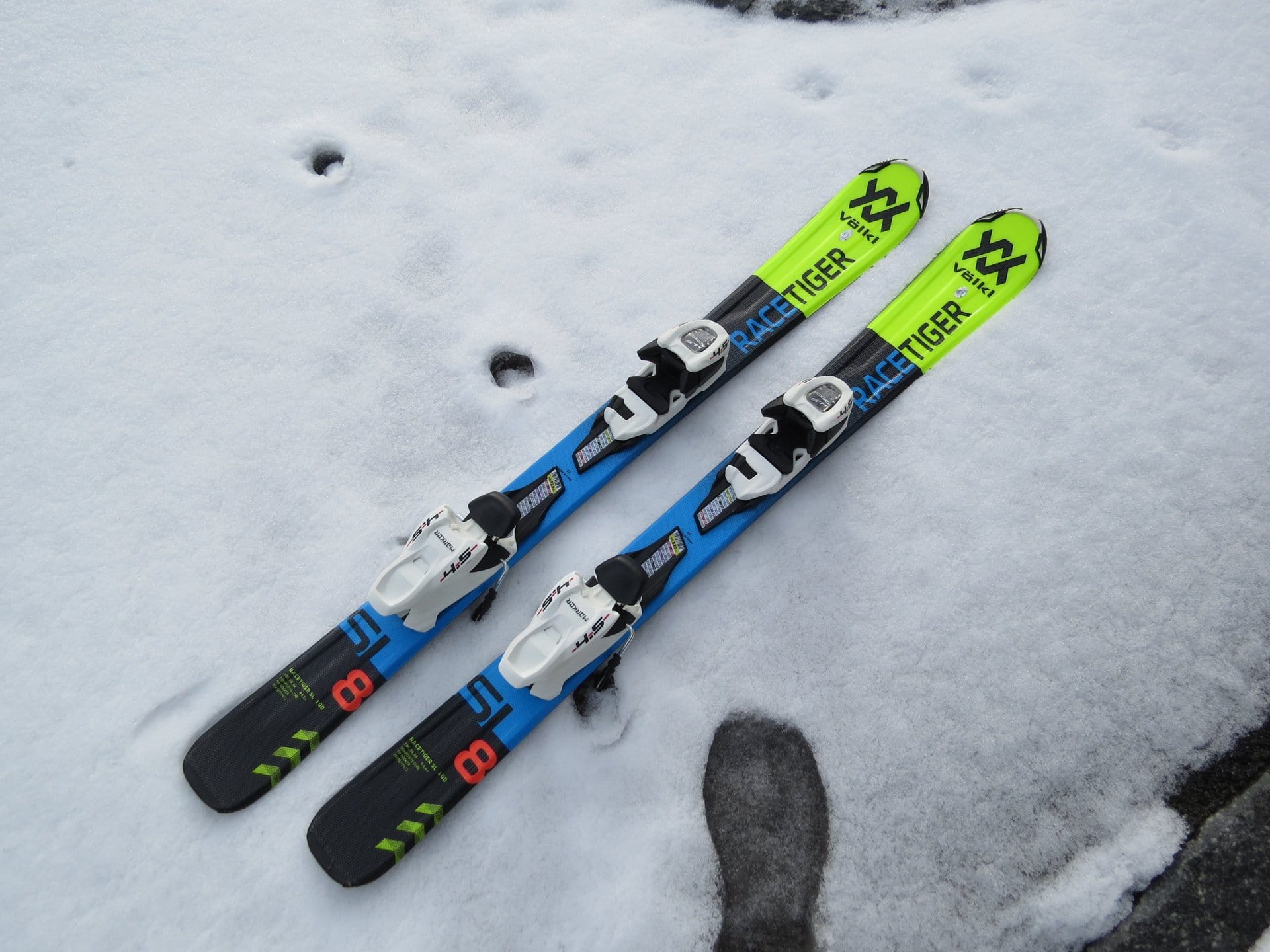
- Binding type and adjustment range. Many kids' skis have an adjustable binding. The sole length range must fit your child's boot: for the models we saw, it is 190 to 310 mm for the Marker 4.5 and 205 to 305 mm for the Rossignol Kid 4. The sole length in millimetres is printed on the boot.
- Age of the binding. Ask for the model and service history. Some workshops no longer adjust older bindings, so ask the shop beforehand.
- Edges, base and sidewall. Ask for photos of the base, the edges and the binding mounting. Deep scratches, cracks or loose edges speak against buying.
- Don't just buy the boots along. Kids' ski boots must fit, and they only suit the foot they were bought for. For boots, you'll find used ski boots in the ski boots category.
Bindings, ski boots and helmet
A specialist workshop always sets the binding. Under the ISO 11088 standard, the release values result from weight, height, age, sole length and skier type. According to manufacturer data (for example Marker 4.5, Rossignol Kid 4), children's bindings cover a release range of 0.75 to 4.5. Whether the binding suits your child's boots is checked by the workshop: it also determines whether children's boots and binding meet the standard.
A helmet is standard and should be bought new, as should protectors: here safety comes before saving. After a fall, a helmet has often lost its protective effect, and you can't see that from the outside.
FAQ
What age are 90 cm kids' skis suitable for?
For children of about 4 to 5 years who are around 100 to 110 cm tall. Beginners also ski on 90 cm at about 120 to 130 cm body height.
What ski length at 125 cm body height?
For beginners 85 to 95 cm, for intermediates 105 to 110 cm, for sporty children 115 to 120 cm.
What ski length for children at 140 cm?
For beginners 100 to 110 cm, for intermediates 120 to 125 cm, for sporty children 130 to 135 cm. According to the age chart, an average child skis on 120 to 130 cm.
What is the right ski length?
It depends on body height and ability: beginners up to the chest, intermediates to chin or nose, sporty skiers to eye level. Light children take the lower end, heavy ones the upper end.
When do adult skis fit?
From about 160 cm body height and 55 kg; sporty skiers often switch earlier (INTERSPORT Rent).
From what age can a child ski?
According to ekosport and INTERSPORT Austria, ski kindergartens often take children from 3 years and many ski schools from 4 years. When your child is ready depends on motor skills and enthusiasm.
When do children need new skis?
When they are more than 15 cm shorter than the recommended length, skill has improved clearly, or the skis are damaged or worn. Intersport Rent gives a guide value of after 2 to 3 intensive seasons.
Should I buy skis that grow with my child?
It's better to take the upper end of the right length than a clearly too long ski. Skis that are too long make learning harder. You can buy a bigger ski used after one or two winters.
Sources: INTERSPORT Rent, "Die richtige Skilänge für Kinder" (updated 12 Oct 2026); SkatePro, Größentabelle Kinderski; DSV aktiv, "Kinderski: Auf die richtige Länge kommt es an" (16 Dec 2025); INTERSPORT Österreich, "Welcher Kinderski ist der richtige" (2024); ekosport, "Welche Skilänge sollte man für Kinder wählen?"; rental prices (Germany/Austria): Ski-Schneider, Sport Gross, Petzen; new prices (Germany): Decathlon, McKinley (retailer pages); binding data: Marker 4.5 (K2), Rossignol Kid 4; growth: WHO Child Growth Standards, MSD Manuals; standard: ISO 11088. Used prices: analysis of 664 kids' ski listings on buycycle, as of 3 November 2026.