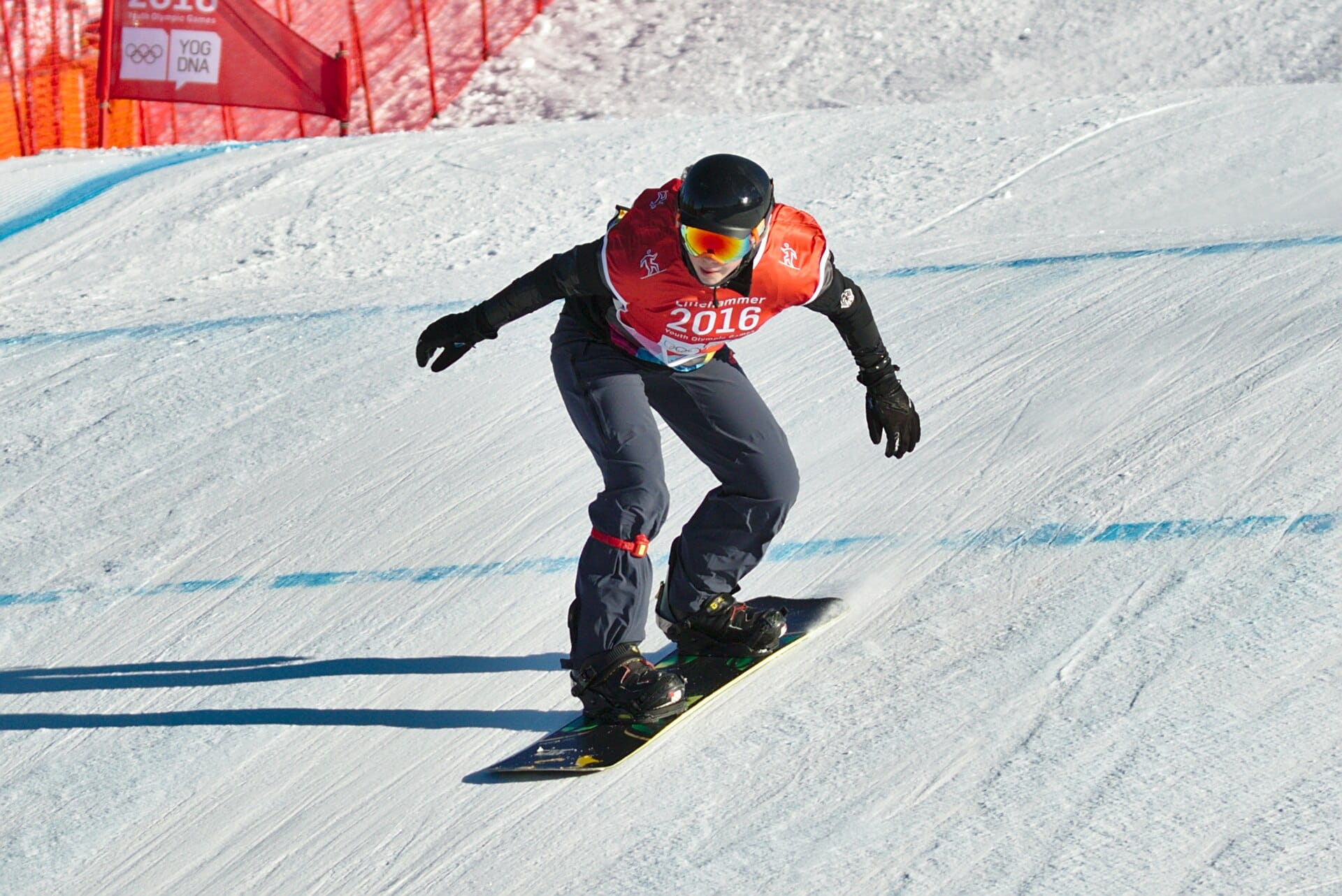
Starting point for an all-mountain board: your height minus 15 to 20 cm. At 175 cm and 75 kg that is 154–161 cm. Your weight shifts the length by a few centimetres (heavier = longer), freestyle boards run 3–5 cm shorter, freeride boards 3–5 cm longer. Width depends on your boot size: up to EU 43 a regular board is fine, from EU 45 you usually need a wide board, and in between it depends on your boot and stance. The manufacturer's weight range for the specific model has the final say.
As of: 2026/27 season. Used-market figures: analysis of more than 1,200 snowboard listings on buycycle (private and commercial), as of 3 November 2026.
Snowboard size in 30 seconds: 5 rules
- Look up the length in the chart. Use height and weight, not just one of them.
- Weight beats height. If you are heavy for your height, go to the upper end of the range (+2 to +4 cm); if you are light, go to the lower end (−2 to −5 cm).
- Adjust for riding style. Freestyle 3–5 cm shorter, freeride 3–5 cm longer, beginners the lower end.
- Check the width via your boot size. Look closely from EU 44, from EU 45 usually wide.
- Read the manufacturer's spec for the model. Every board has a weight range and a waist width. If you are within it, it fits.
Snowboard size chart by height and weight
At 175 cm and around 75 kg, an all-mountain board is 154–161 cm. The chart applies to adults of average weight for their height.
| Height (cm) | Typical weight (kg) | All-mountain (cm) | Freestyle (cm) | Freeride (cm) |
|---|---|---|---|---|
| 150 | approx. 50 | 131–139 | 127–135 | 134–142 |
| 155 | approx. 55 | 136–144 | 132–140 | 139–147 |
| 160 | approx. 60 | 141–149 | 137–145 | 144–152 |
| 165 | approx. 65 | 146–154 | 142–150 | 149–157 |
| 170 | approx. 70 | 150–157 | 146–153 | 153–160 |
| 175 | approx. 75 | 154–161 | 150–157 | 157–164 |
| 180 | approx. 80 | 158–165 | 154–161 | 161–168 |
| 185 | approx. 85 | 162–168 | 158–164 | 165–171 |
| 190 | approx. 90 | 164–170 | 160–166 | 167–173 |
| 195 | approx. 95 and more | 166–172 | 162–168 | 169–175 |
Method: The all-mountain column is the rounded average of the freely available size-and-weight charts from Skiinfo, Montec and Snowleader. Freestyle and freeride are the all-mountain values minus 3–5 cm and plus 3–5 cm respectively, as the riding-style recommendations of the sources suggest. The chart is a starting point, not a manufacturer approval. For women, 2–5 cm less often applies (see below).
Which snowboard size at 163, 170, 175, 180 and 185 cm?
- 163 cm (approx. 62 kg): all-mountain 144–152 cm, freestyle 140–148 cm, freeride 147–155 cm.
- 170 cm (approx. 70 kg): all-mountain 150–157 cm.
- 175 cm (approx. 75 kg): all-mountain 154–161 cm.
- 180 cm (approx. 80 kg): all-mountain 158–165 cm.
- 185 cm (approx. 85 kg): all-mountain 162–168 cm.
All five values assume average weight and a mix of piste and off-piste riding. If you weigh closer to 65 kg at 180 cm, you move to the lower end (158 cm); at 95 kg, to the upper end (165 cm).
Snowboard size by height or weight: which matters more?
Weight. It decides how hard you load the board and how it flexes under you. Height is only a proxy.
Manufacturers and retailers agree on this (Montec, Skiinfo). In practice that means:
- Check the manufacturer's weight range. Almost every board has one on its spec sheet. At the bottom of the range the board feels stiff and nervous, at the top sluggish and soft.
- Between two lengths? A light rider takes the shorter one, a heavy rider the longer one.
- How much difference does it make? In Snowleader's chart, at 180 cm there are only about 5 cm (158 to 163 cm) between 60 kg and 100 kg. The charts are tighter than many calculators suggest.
What about the chin rule?
The old rule: stand the board upright, with the tip between your chin and nose. For all-mountain that often still roughly works, but it is only a cross-check. Rules based purely on height are 15–25 cm apart, depending on whether "shoulder", "chin" or "height minus 20 cm" is meant. Your weight and riding style do not appear in them. Use the chart as the method and the chin rule as a plausibility check.
Length by riding style and shape
Freestyle shorter, freeride longer: 3–5 cm is the norm, though this does not always apply to boards with a lot of volume or setback.
- All-mountain: middle of the chart range. Works for piste, off-piste and the occasional powder day.
- Freestyle and park: 3–5 cm shorter, soft and agile. Beginners stay with the all-mountain length in the park too.
- Freeride and powder: 3–5 cm longer for more float and stability at speed. Longer does not mean endless: if you are 175 cm tall, you do not need a 170.
- Carving: rather narrow and long, but the manufacturer's weight range applies here too.
- Volume-shifted (short and wide): you ride these boards deliberately shorter. Depending on the brand, about 3–6 cm less is common. Be sure to read the brand's own size chart.
- Directional and twin: a directional board with a long nose and short tail rides longer than its overall length suggests, because the contact length counts (Montec). A true twin rides as long as it is.

Snowboard width: which width for which boot size?
Up to EU 43 a regular board fits, at EU 44–45 it is a borderline case (mid-wide), from EU 45 you usually need a wide board. What matters is that toes and heel overhang the edge by no more than about 2 cm.
Width is measured at the narrowest point of the waist. Too narrow means your boot drags in the snow and you fall in tight turns. Too wide means sluggish edge changes.
| Boot size (EU) | Waist width (cm) | Class |
|---|---|---|
| 35–37 | approx. 23.5 | Regular (kids' and women's boards) |
| 37–40 | 24.0–24.5 | Regular |
| 40–42 | approx. 25.0 | Regular |
| 42–43 | 25.0–25.5 | Regular |
| 44–45 | 25.5–26.0 | Mid-wide (borderline) |
| 45–47 | 26.0–26.5 | Wide |
Method: Guide values from Skiinfo (width by boot size), Picture (regular/mid-wide/wide classes), Jones (regular board up to US 10 / EU 44), Burton (consider a wide board from US 11 / EU 44) and the overhang rule from the Snowboarding Profiles guide (maximum of about 2 cm per edge). The sources put the cut-off at EU 42, 43, 44 or 46; the chart therefore sets a transition zone at EU 44–45. Fit depends on the boot: a low-profile boot tolerates more overhang than a bulky one.
Why the sources disagree
Boot size is only an approximation. What counts is the length of the boot sole relative to the waist width, and your binding angles. Steep angles turn the boot across the board and increase the overhang. Flat angles or a duck stance reduce it. Two people at EU 44 can therefore need different boards.
What do W and MW mean in a model name?
Brands mark wide boards with a suffix: W or Wide (for example "156W"), MW or Mid-Wide (for example "159MW"). The number stays the length. The exact waist width is on the spec sheet, and that is where it counts: one brand's "Wide" can be as wide as another brand's "Mid-Wide".
How do I check it myself?
Put your boot on the board (or in the adjusted binding) and see how far toe and heel stick out. More than about 2 cm per side is too much. Have a shop or a snowboard instructor set up the binding and stance: snowboard bindings do not release in a fall, so the setup has to be right.
Which snowboard size for beginners?
Beginners ride the lower end of the range: shorter is easier to turn and more forgiving. Pair it with a soft all-mountain twin with a rocker or hybrid profile.
- Length: the lower end of your row in the chart, roughly chin to mouth.
- Shape: true twin or directional twin, flat or rocker. A pronounced sidecut helps in turns (Skiinfo).
- Not too small: too short is nervous at speed. One or two centimetres under the chart is fine, ten is not.
- Rent or buy used? If you only ride a few days, rent. If you ride every season, a used board pays off: the median used snowboard is listed on buycycle for €275 (figures below). Boots and bindings have to fit you either way.
- Book a lesson. The first days with an instructor save you falls and frustration. And wear a helmet. Buy that one new, because with a used one you cannot know whether it has already taken a hit.
Women's and kids' snowboards
Women's boards are usually 2–5 cm shorter, softer and narrower than men's boards for the same height. Kids' boards are 10–15 cm shorter than the child.
For women, the Skiinfo chart gives 143–146 cm at 51–60 kg (1.42–1.56 m) and 147–150 cm at 61–70 kg (1.57–1.67 m) as a guide. That fits "men's chart minus 3–5 cm". Women with big feet should check the width in particular, because women's boards are narrower.
| Child's height (cm) | Board length (cm) |
|---|---|
| 110 | 95–100 |
| 120 | 105–110 |
| 130 | 115–120 |
| 140 | 125–130 |
| 150 | 135–140 |
Method: rule of thumb "height minus 10–15 cm" (Picture), cross-checked against its age bands (5–7 years: 80–100 cm, 8–10 years: 100–120 cm, 11–13 years: 115–140 cm). Skiinfo's kids' chart (26–45 kg: 80–90 cm) does not match this and is not used here. A guide value, not a substitute for advice from a specialist shop.
No "room to grow". A board that is too long is hard for kids to control and therefore a fall risk. Rather get the right size used each season and sell it on afterwards.
Too long or too short: is that bad?
±2–3 cm is no problem. More than 5 cm off and you will feel it.
- Too long: hard to turn, tiring, sluggish. Beginners in particular lose interest. On the plus side, it is stable at speed and in powder.
- Too short: agile, but nervous at speed and sinking in deep snow. Heavy riders overload the board.
- Too narrow: boot drag in turns.
- Too wide: slow edge changes.
When in doubt, take the shorter one as a beginner and the longer one as a freerider.
Buying used without trying: how to check the size
The length is printed on the board, the important data is on the spec sheet for the model year. Check both before you buy, and ask for measurements.
Spec check in 3 steps
- Determine the length from the chart (height, weight, riding style).
- Look up model and year on the brand's spec sheet: weight range, waist width, effective edge length. Check the manufacturer's data for the model year, because the same model changes from year to year.
- Compare the waist width with your boot and angles (see above).
Where is the size printed? Usually on the topsheet, base or edge, often in the model name ("Ripper 126", "Manic 155"). W or MW in the name means a wide variant.
Measure or ask: ask the seller for the length from tip to tail, the width at the narrowest point and a photo with a tape measure. The width is not always in the listing, so asking is worthwhile.
Check the condition
- Edges: rust or cracks
- Base: core shots down to the core
- Nose and tail: delamination (layers coming apart)
- Inserts: stripped threads
- Camber: does the board still spring back as it should on a flat surface?
- Binding: 4×4, 2×4 or Burton Channel: does the binding fit the board?
With damaged edges, delamination or broken inserts: do not buy, or have a workshop check it.
Which lengths are available used on buycycle?
Almost three quarters of all listings are 150–164 cm. If you are taller than 185 cm or heavier, you will find less choice.
| Length | Share of listings with a length | Median listing price |
|---|---|---|
| under 140 cm (mostly kids) | 8% | approx. €190 |
| 140–149 cm | 12% | €267 |
| 150–154 cm | 19% | €270 |
| 155–159 cm | 35% | €300 |
| 160–164 cm | 18% | €315 |
| 165–169 cm | 4% | €300 |
| 170 cm and more | 3% | €400 |
Method: analysis of 1,247 snowboard listings on buycycle (private and commercial), all listings posted since launch including those already sold (as of 3 November 2026). 1,006 of them state a length and form the basis of the shares. Price = median listing price in €. These are asking prices, not selling prices; the values from 165 cm rest on few listings (41 and 29). Splitboards are included.
The smaller the board, the bigger the choice. Around 73% of listings are between 150 and 164 cm. That covers riders from about 160 to 180 cm well. If you are taller or heavier, 165s and longer are rare: only 7% of listings. In that case, ask the seller whether other boards are available, or check new listings regularly.
What do used snowboards cost?
A used snowboard is listed on buycycle for a median of €275. So far 93 boards have sold, at a median of €230 and after 17 days.
| Age of the board | Number of listings | Median listing price | Share of new price |
|---|---|---|---|
| 0–1 years | 212 | €329 | 57% |
| 2–3 years | 172 | €290 | 54% |
| 4–5 years | 93 | €295 | 49% |
| 6–7 years | 60 | €238 | 43% |
| 8 years and older | 146 | €180 | 42% |
Method: same basis as above; age = 2026 minus model year, listings without a model year are missing from the table. Share of new price = listing price divided by the new price stated in the listing, where one is given. Selling price and time to sell are based on 93 sales.
Boards lose little value in the first years: a board up to 3 years old is still listed for more than half of its new price on median. Older boards are cheap but more likely to show wear; the condition list above then counts double.
You will find matching bindings in our snowboard and splitboard bindings category.
Splitboard length in brief
Ride a splitboard at roughly the length of a freeride board, rather at the upper end. For the climb and the descent off-piste, longer, stiffer boards are more stable (Montec). Check the manufacturer's chart for the model, because splitboards depend heavily on the model.
FAQ
Which snowboard for which height?
At 160 cm about 141–149 cm, at 170 cm 150–157 cm, at 180 cm 158–165 cm, at 190 cm 164–170 cm (all-mountain, average weight). The complete chart is above.
How do I calculate the right snowboard size?
Look up height and weight in the chart, then adjust for riding style: freestyle 3–5 cm shorter, freeride 3–5 cm longer. Finally, check the manufacturer's weight range.
Which snowboard size at 163 cm?
About 144–152 cm as an all-mountain board at around 62 kg. Freestyle 140–148 cm, freeride 147–155 cm.
Is it bad if the snowboard is too big?
Up to about 3 cm it is no problem. Clearly too long means harder to turn and more tiring. This mostly affects beginners.
What size snowboard do I need?
It depends on weight, height, riding style and ability. As a starting point for all-mountain: height minus 15–20 cm, then factor in weight and style.
Snowboard size by height or weight?
By weight; height is a proxy. Check the board's weight range on the spec sheet.
What does W mean on snowboards?
W stands for Wide, MW for Mid-Wide. The number before it is the length in cm. The exact waist width is on the manufacturer's spec sheet.
Which snowboard size at 180 cm?
158–165 cm as an all-mountain board at around 80 kg. At 65 kg rather 158 cm, at 95 kg rather 165 cm.
Do I need a wide board?
Usually from boot size EU 45. At EU 44–45 it depends on your boot and binding angle; a mid-wide board is often the answer. Up to EU 43 a regular board is enough.
Sources: Skiinfo.de, "Die perfekte Snowboard-Größe" (as of July 2026); Montec Magazin, "So kannst du die Größe deines Snowboards berechnen"; Snowleader.de, "Welche Größe für mein Snowboard?"; Picture Organic Clothing, size guide (October 2026); Burton Blog, "Do I need wide fit snowboard boots?"; Jones Snowboards, wide boards; Snowboarding Profiles, "How important is snowboard width sizing" (overhang and width by boot size). Used-market figures: analysis of 1,247 snowboard listings on buycycle, as of 3 November 2026.