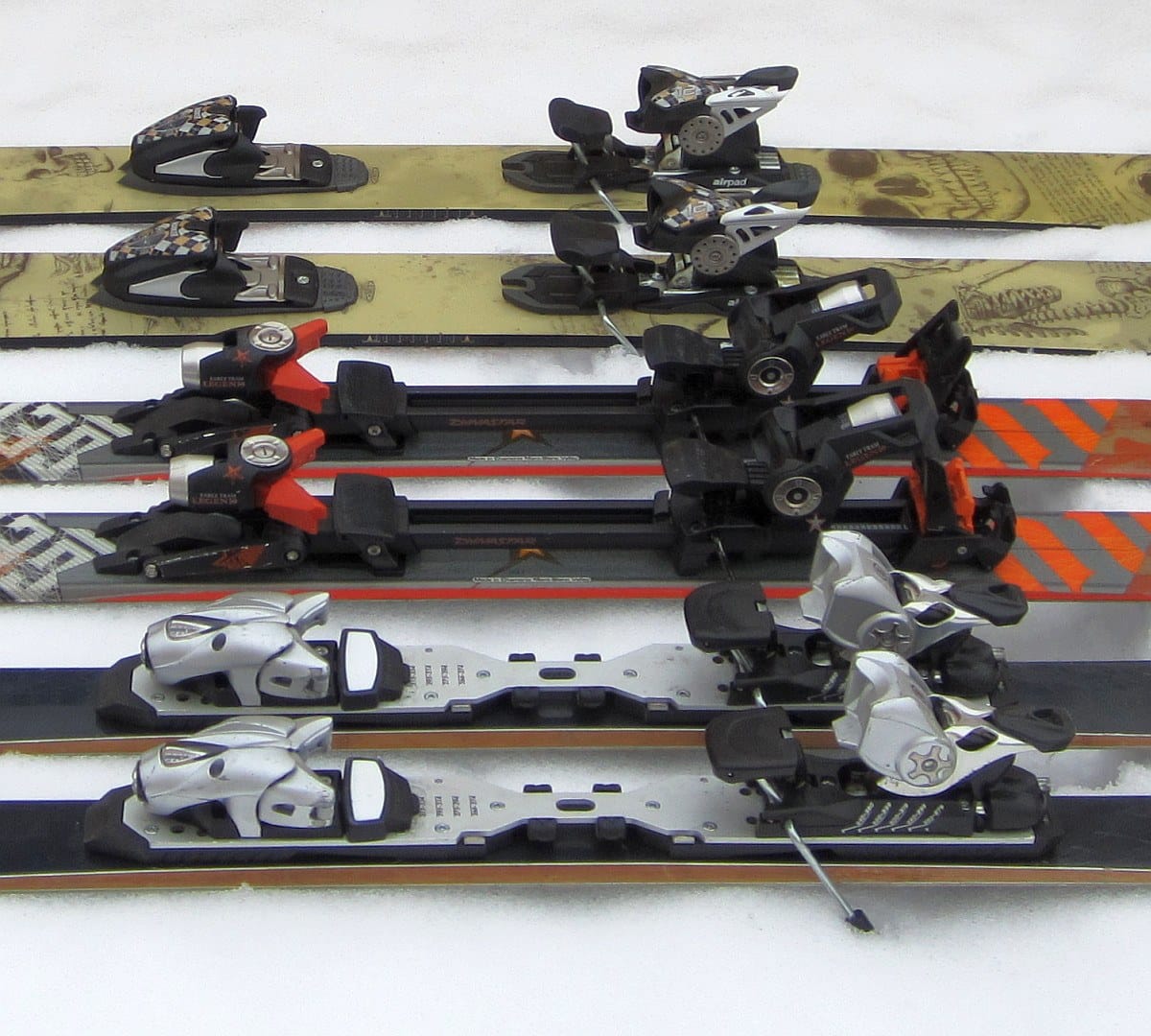
The release value (also called Z value or DIN value) of your ski binding depends on your weight, height, age, boot sole length and skier type. The ISO 11088 chart below gives you the orientation value. But the binding itself should be set and checked on a test device by a certified ski shop: that usually costs €15–20 per pair. This applies even more to used skis, because the previous owner's setting does not fit you.
As of: November 2026. The chart is an orientation value to help you understand the system, not instructions for setting your binding. How high your binding should release is determined by a certified workshop with a test device.
What is the release value (DIN value)?
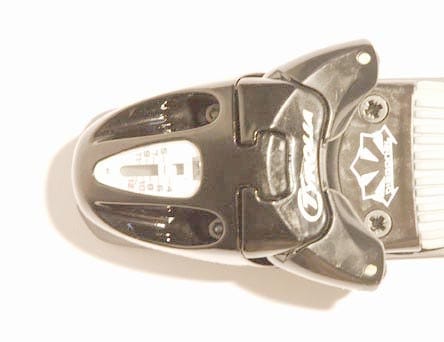
The release value is the number that determines how much force it takes for your binding to release the ski boot. Z value, DIN value and release value all mean the same thing. Depending on the model, the scale on the toe and heel pieces runs, for example, from 3 to 10 or from 6 to 14.
A higher value means the binding releases later. Both extremes are risky. If the value is too low, you lose the ski in a hard turn. If it is too high, the ski stays on your boot for too long in a fall.
By the way, the standard is called ISO 11088 (in Germany DIN ISO 11088), not "DIN 11088". The current edition dates from 2023.

How do I find my DIN value? In 4 steps
You need five details: weight, height, age, sole length in millimetres and your skier type. Then you read the chart like this (weight method according to ISO 11088):
- Find the row: Weight and height each give you a row (code A to O). If they do not match, the upper row applies, that is the one with the lower value.
- Find the column: The sole length of your ski boot determines the column. Longer sole, lower value, because the lever on your leg is longer.
- Correct for skier type: Type 1 stays in the row. Type 2 moves one row down (higher value), type 3 moves two rows down.
- Correct for age: Children up to 9 years and skiers aged 50 and over move one row up (lower value).
Where do I find the sole length?
The sole length is a three-digit number in millimetres, stamped on the outside of the ski boot near the heel. It is not your shoe size and not the Mondopoint size. A boot in Mondopoint 27.5 has a sole length well over 300 mm. If the stamp is missing, measure the sole on the outside from the tip to the end of the heel.
Which skier type am I?
| Type | How you ski | Correction |
|---|---|---|
| Type 1 | Beginner or cautious, mostly easy to moderately steep slopes, slow to medium speed | none |
| Type 2 | Advanced, moderately steep to steep slopes, sometimes fast | 1 row down |
| Type 3 | Fast and aggressive, mainly steep slopes | 2 rows down |
The standard also has intermediate levels (type -1 and 3+). Only a certified workshop assigns those.
DIN chart according to ISO 11088 (weight method, as of 2026/27)
The chart gives the starting values for type 1 and ages 10–49. It does not replace setting the binding in a ski shop. Read it using the four steps above. A dash means this combination of row and sole length does not exist in the chart.
| Code | Weight (kg) | Height (cm) | up to 250 mm | 251–270 | 271–290 | 291–310 | 311–330 | over 330 |
|---|---|---|---|---|---|---|---|---|
| A | 10–13 | 0.75 | 0.75 | – | – | – | – | |
| B | 14–17 | 1.00 | 1.00 | 0.75 | – | – | – | |
| C | 18–21 | 1.50 | 1.25 | 1.00 | – | – | – | |
| D | 22–25 | 1.75 | 1.50 | 1.50 | 1.25 | – | – | |
| E | 26–30 | 2.25 | 2.00 | 1.75 | 1.50 | 1.50 | – | |
| F | 31–35 | 2.75 | 2.50 | 2.25 | 2.00 | 1.75 | 1.75 | |
| G | 36–41 | 3.50 | 3.00 | 2.75 | 2.50 | 2.25 | 2.00 | |
| H | 42–48 | up to 148 | – | 3.50 | 3.00 | 3.00 | 2.75 | 2.50 |
| I | 49–57 | 149–157 | – | 4.50 | 4.00 | 3.50 | 3.50 | 3.00 |
| J | 58–66 | 158–166 | – | 5.50 | 5.00 | 4.50 | 4.00 | 3.50 |
| K | 67–78 | 167–178 | – | 6.50 | 6.00 | 5.50 | 5.00 | 4.50 |
| L | 79–94 | 179–194 | – | 7.50 | 7.00 | 6.50 | 6.00 | 5.50 |
| M | 95+ | 195+ | – | – | 8.50 | 8.00 | 7.00 | 6.50 |
| N | only after correction | – | – | 10.00 | 9.50 | 8.50 | 8.00 | |
| O | only after correction | – | – | 11.50 | 11.00 | 10.00 | 9.50 |
Sources: ISO 11088 (weight method), cross-checked against the Z value chart from Fischer Sports (manufacturer blog, 2024), snow-online.de and the calculator at rechner-portal.de, which cites Stöckli Switzerland. The values agree across all three sources. Only in the last row does Fischer give 11.00 instead of 11.50; we used 11.50 because two sources list it. As of: 3 November 2026.
Worked examples
Example 1: woman, 35 years old, 58 kg, 165 cm, sole 300 mm, type 1. Weight and height give code J, the sole falls in the 291–310 column. Type 1 and age 10–49 mean no correction. Orientation value: 4.00.
Example 2: man, 40 years old, 82 kg, 183 cm, sole 315 mm, type 3. Code L, column 311–330: 6.00. Type 3 means two rows down, so code N: 8.50.
Example 3: man, 55 years old, 80 kg, 180 cm, sole 320 mm, type 2. Code L (6.00 in column 311–330). Type 2 moves one row down (code M), age 50 and over moves one row up again. Back at code L: 6.00.
Example 4: child, 8 years old, 30 kg, sole 240 mm, type 1. Code E, column "up to 250": 2.25. One row up because of age, code D: 1.75.
With children this is an especially good reason to go to a shop, because they grow and change boots almost every season.
Ski length plays no role in the DIN value. Formulas from social media videos do not replace the chart from the standard either.
What gets adjusted on a binding?
Three things are set: the fit to the sole length (so that the heel piece holds the boot with the right pressure), the release value at the toe piece and the release value at the heel piece. The toe height and the AFD are checked as well.
The AFD (Anti-Friction Device) is the sliding element at the toe piece on which the boot toe slides sideways when the binding releases. If it is dirty or worn, the binding releases worse, no matter what the scale says.
This is deliberately not a step-by-step guide. Setting a binding is not just about turning screws, but about what is measured afterwards.
Set it yourself or go to a ski shop?
Go to a ski shop. Setting it yourself is technically possible but not advisable, because without a test device you do not know whether the binding really releases at the value shown on the scale.
The test device measures the actual release torques. That matters because springs age and the scale is only a setting mark. You also get a receipt from the test device. In Switzerland, the bfu ski sticker (Skivignette) confirms that a specialist has set the binding and checked it on a test device. The bfu recommends this before every season and advises bringing your ski boots and asking for the test device receipt.
A point worth knowing: a correctly set binding mainly protects against lower leg fractures. It does not reliably protect against knee injuries such as a torn cruciate ligament. That also means turning the value up "to be safe" does not make you safer.
How much does it cost to have ski bindings set?
In Germany, setting the binding usually costs €10–30 per pair in a ski shop, often €15–20 including a function test. Some shops do it free or cheaper when you buy or as part of a ski service. The prices below are from German retailers and are meant as a guide: prices in other countries and shops differ.
| Service | Typical price in Germany (as of November 2026) |
|---|---|
| Setting the binding (manual setting according to ISO 11088) | from about €15 (Decathlon Germany: €14.99) |
| Setting on a test device with calibration | about €15–20 (Decathlon Germany: €19.99) |
| Mounting a new binding, including setting | about €20–30 according to SnowTrex |
| Full ski service with base and edges, incl. binding check | e.g. Sport Conrad €30 or €50 |
Prices from retailer websites in Germany, they vary by branch. Ask beforehand whether a test device is used, and check what shops near you charge.
How often does the binding need to be set?
At least once per season, and always after one of these occasions:
- You bought new ski boots (even the same model, because of sole length and wear).
- You have gained or lost a lot of weight.
- You now ski faster or on steeper terrain than before (a different skier type).
- You bought used skis.
- It is about a child: every year, often in between as well.
Does every ski boot fit every binding?
No. The boot sole has to match the binding, otherwise in the worst case it releases wrongly or not at all. The sole standard of your boot is usually on the heel stamp or in the manufacturer's data.
| Sole standard | Boot type | Fits |
|---|---|---|
| ISO 5355 | classic alpine boot with a flat sole | almost all alpine bindings |
| ISO 23223 (GripWalk) | alpine boot with a rubberised, rounded sole | only bindings approved for it (GripWalk, MNC, ID, AT) |
| ISO 9523 | touring boot with pin inserts | touring bindings; in alpine bindings only if the manufacturer allows it for that binding |
Compatibility is stated in the manual or on the binding (logo). If in doubt, ask the workshop. The test device does not always detect wrong boot and binding combinations and can then show a deceptively good result (bfu).
Buying used skis with bindings: the checklist
93% of used skis on buycycle are offered with bindings (5,232 of 5,625 listings with this information, analysis of 3 November 2026). When you buy used skis, you almost always buy a used binding too. You clarify seven points before buying:
- Binding model and year: Ask the seller. Older bindings can drop off the manufacturers' lists that many workshops follow (so-called release or indemnification lists). The workshop may then refuse to set them. Ask beforehand whether they will set that model.
- Age of the binding: As a rule of thumb, around ten years is considered the end of a binding's life. That is not a standard but a practical estimate. With an older binding, rather choose another listing.
- DIN range: Ask for a photo of the scale (for example 3–10 or 6–14). Your value from the chart must be within the range, ideally not right at the edge. On buycycle, 46% of bindings with a DIN range stated have 6–14, 30% have 3–10, 14% have 8–16 and 10% have 10–18 (n = 1,578). With 3–10, very heavy or very fast skiers quickly run out of range.
- Sole standard and length: Does the binding fit your boot (alpine ISO 5355 or GripWalk ISO 23223) and does its length range cover your sole length? That belongs in a photo too.
- Brake width: The brake has to match the waist width of the ski.
- Condition: No cracks, no corrosion, no play. The toe piece and the AFD must be clean and undamaged.
- Final check: Ask when the binding was last in a workshop. The seller's setting says nothing about yours.
Even if the seller writes that the binding is set: it was set for another skier and possibly for another boot. Go to the workshop before your first run. Budget about €15–20 extra for this (German price), or about €20–30 if a binding has to be newly mounted (German prices, see above).
FAQ
Which DIN chart is there for ski bindings?
The ISO 11088 standard describes the procedure. The chart above shows the values of the weight method. There is also the tibia method, which measures the width of the top of the shin bone. It is mainly used in Germany; whether it is still common, it is best to ask the workshop.
How much does it cost to have the binding set?
In Germany usually €10–30 per pair, often €15–20 with a function test. Mounting a new binding costs about €20–30 including setting (German prices).
Can you set the ski binding yourself?
Technically yes, but it is not recommended. Without a test device you do not know whether the binding really releases at the value you set.
How do I find my DIN value?
With weight, height, age, sole length and skier type from the chart above. The workshop sets the final value.
Does every ski boot fit every binding?
No. The sole standard (ISO 5355, ISO 23223 GripWalk, ISO 9523 touring) has to match the binding, see the table above.
What DIN value do children need?
Children of 10 to 13 kg start at 0.75, a child of 30 kg with a sole up to 250 mm ends up at 1.75 after the age correction. Because size and boots change every year, the setting belongs in the workshop every season.
What applies from 95 kg?
From 95 kg or 195 cm the chart starts at code M (8.50 to 6.50 depending on the sole), and with the skier type correction it goes up to code O (up to 11.50). A workshop sets and tests values like these.
Does the DIN value depend on ski length?
No. Ski length plays no role in the DIN value.
Should I relax the binding in summer?
That depends on the manufacturer. What applies to your binding is in its manual. You will have it checked before the next season anyway.
Sources: ISO 11088 (Alpine ski-binding-boot system: assembly, adjustment and inspection, 2023 edition); Z value charts from Fischer Sports, snow-online.de and rechner-portal.de (Stöckli Switzerland); bfu (Swiss Council for Accident Prevention), notes on binding setting and the ski sticker (in German); prices from Decathlon, Sport Conrad and SnowTrex (Germany); analysis of 5,625 ski listings (with binding information) and 1,578 listings with a DIN value on buycycle (private and commercial), as of 3 November 2026.